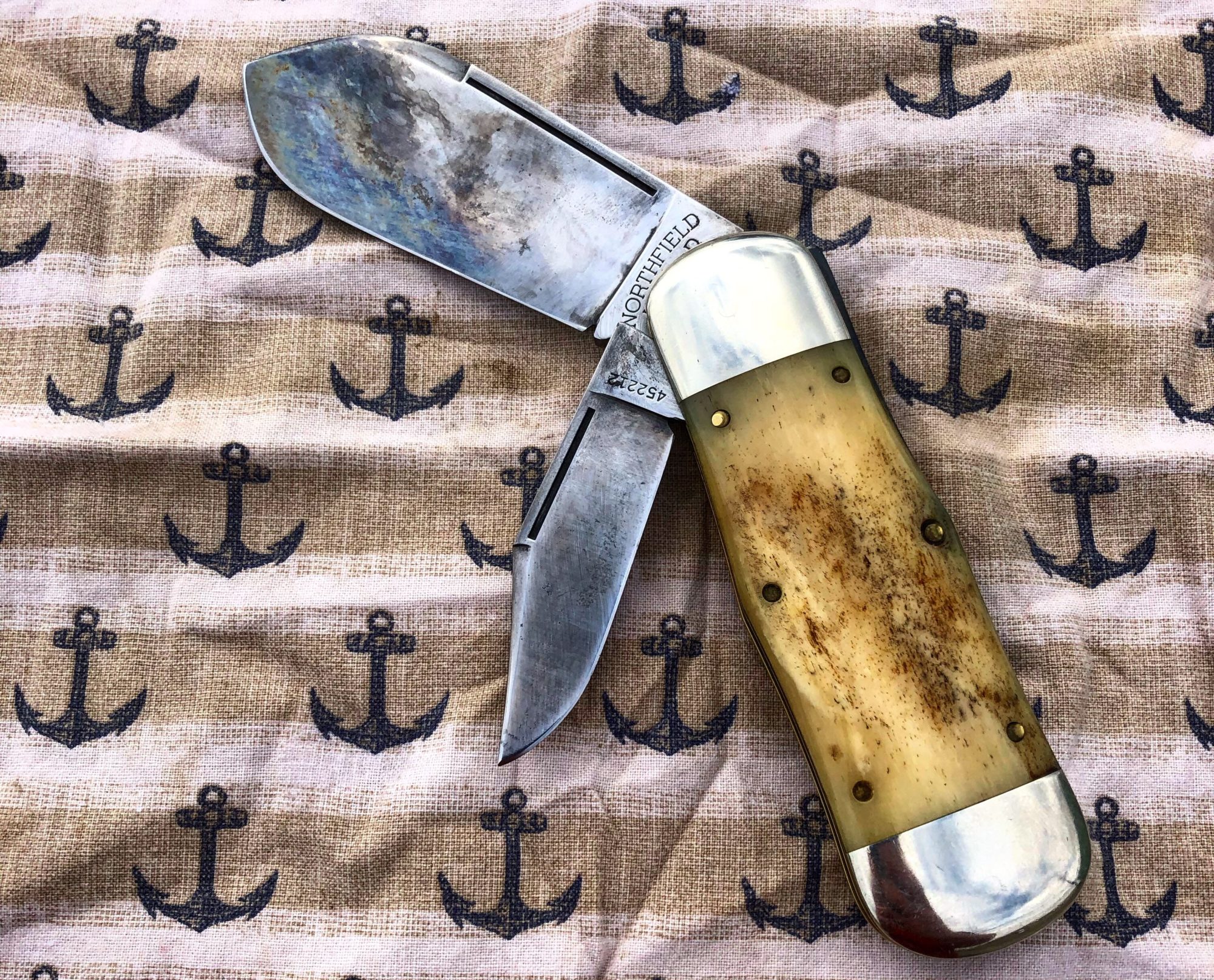
Knife Construction Methods; Pinned vs Riveted vs Screwed

One of the most important factors in how a knife functions is how it is put together. Among folding knives the three most common methods of holding the parts of a knife together are pinning, riveting, and screwing. Each of these three construction methods have their own merits and downfalls. In this article I will discuss the characteristics of each construction method and my opinions on them.


Pinned

Pin construction is probably the oldest and simplest of the three types discussed here. It involves a cylinder or tube, usually of some kind of soft metal like brass, being placed through consecutive holes in the handle. The pin transects the covers, liners, and usually a backspring or lockbar of the knife. The pin can either be held in place with glue, as often seen on fixed blades, or by the act of peening. Peening is when each end of the pin is hammered to create expansion, which holds it in place against the handle material.

Pin construction is most often seen on slipjoint knives, and is highly associated with “traditional” aesthetics. The only modern (i.e. one hand opening, locking, pocket clip) knives I can think of that have pin construction are Spyderco’s stainless steel handled knives.

Case knives tend to have traditional pinned construction, with the pins even with the surface of the cover material. Many traditional knife enthusiasts prefer the look of true pinned knives over other construction methods, because it gives a cleaner overall appearance.

Unfortunately, pinning is probably the least maintainable of the three methods discussed here. If a pinned knife becomes loose you’ll have to rehammer the pin, which can be both delicate and imprecise. Since friction is the only force holding the parts in place, the pieces of a pinned knife can move more than those in riveted or screwed knives.

Despite pinning’s practical downfalls, I still love how a pinned knife looks. There’s something indescribably classy about a pinned construction knife.

Pin construction knives.

Riveted

Riveted handles are often confused as pinned, but there’s an important difference between the two. A riveted handle has heads that actually form an overhang, or structural barrier, upon which they rest. This makes a significant improvement in durability over pinned construction, because the overhang precludes gradual development of space and play. While riveted handles are even less maintainable than pinned handles, as they canโ€™t be taken apart without extensive work, they generally don’t need any maintenance when made correctly. That said, it’s important for riveted handles to be done correctly, with the end user in mind. When done so the action can be extremely smooth but still solid and without play.

Spyderco sometimes uses rivets. Particularly, some of their โ€œlightweightโ€ and plastic handled knives are held together by rivets. On some, like the Manix 2 Lightweight, the pivot is held by a screw so that it can be adjusted if necessary. I have had several riveted knives from Spyderco and have never had an issue arise from the riveted construction or its impedance to disassembly, and have found them to rarely need maintenance.

Interestingly, Great Eastern Cutlery made knives are often not only “pinned” in a traditional sense but also “spun”. That means that some of the pins are expanded via spinning, rather than hammering, which creates a rounded surface to the pins that isnโ€™t level with the covers. I would consider these to be riveted. Some traditional knife enthusiasts dislike the look of these spun rivets, but they certainly provide more rigidity to the knifeโ€™s construction.

Victorinox excels in their application of riveted handles. From the exposed rivets on their Alox models to the hidden ones on their plastic handles knives, Victorinox makes solid but smooth knives with a consistency thatโ€™s arguably unparalleled in the industry.

For me, the durability of riveted handles far outweighs the difficulty in disassembly and maintenance, when theyโ€™re done right.

Riveted construction knives. The Northwoods Heritage Jack on the left with combination pin and rivet construction and Spyderco Manix 2 Lightweight with rivet and screw construction.

Screwed

Screwed constructions is most common in modern knives, but has growing prevalence in slipjoint knives also in recent years. Most modern, i.e. one hand opening and locking, knives are made with screwed construction.

Screw construction uses screws that can, generally, be adjusted and even removed using the appropriate bits. There are several variations on how screws are used, but they often either screw into a tube from both sides of the knife or have a โ€œmaleโ€ and โ€œfemaleโ€ screw on either side of the knife that screw directly into each other. I find screw construction knives typically require removable threadlocker to remain solid and not loosen through use. That said, they definitely offer much easier disassembly and more maintenance options.

While screw construction is ubiquitous on modern knives, more and more slipjoint knives with traditional influences are coming to market with screw construction. CollectorKnives / LionSteel, Benchmade, Spyderco (which has had their SlipIt line for a while), Rough Ryder, and many other brands are bringing more knives to the market with traditional aesthetics and slipjoint mechanisms but foregoing traditional construction for screw construction. I love to see more people become familiar with slipjoint and traditional knives and, though I don’t like the look of screw construction on them as much, I appreciate the accessibility that screw construction offers through its greater adjustability.

Screw construction knives.

When it really comes down to it, I believe all three of these construction methods are valid and acceptable. Certain knives work better as one method than the other, whether from an aesthetic or functional standpoint. I think the main factor that determines if a particular construction method works for a particular knife is whether that method is applied correctly to a high quality level and with consideration for the knife’s overall aesthetic and intended use.


I sincerely thank you for your time, support, and interest! Don’t forget to tell your friends about KnifeThoughts.com, subscribe via email, and share this article on social media. You can find Knife Thoughts on YouTube where I have hundreds of knife videos, as well as on Instagram and Facebook!

CIVIVI Dogma Review; Modern EDC Knife with Traditional Inspiration

Over the last couple years I seem to have become a fan of WE knives. First, I got the MassDrop Keen. The Keen was designed by Ray Laconico and manufactured by WE, and it is one of my favorite knives. WE gave the knife a level of quality that lived up to its beautiful design. Then, Ben Petersen of Knafs Co sent me a WE Banter for review. I enjoyed the design more than I expected, but there was no doubt that it was an extremely well made knife. Next, I took advantage of a Black Friday sale to finally get a knife I’d been wanting since its release, the CIVIVI (WE’s more budget friendly brand) Wyvern. I was particularly happy with the Wyvern; I felt that it kept the quality construction of the WE knives I had despite the more budget friendly (but still more than adequate for practical use) materials, and provided a really great value.

Then, I had an issue with the Wyvern. The detent, which keeps the blade securely in the handle, seemed to have loosened. This allowed the tip of the blade to rise above the frame of the knife, what you might call a “proud tip” in a traditional knife, which I wasn’t comfortable with. I contacted CIVIVI customer service and, frankly, was blown away by the experience I received. The people whom I emailed with were responsive, friendly, and helpful. Not only that, but my issue was fixed by the US based service center much quicker than I expected (or have experienced from some other brands).

After that process, CIVIVI asked if I’d be interested in reviewing any of their knives. Since I had about 10 of them on my (extensive) “To Buy” list, I was excited for the opportunity. I gave them a list of a few I was interested in, and they sent out a Dogma. So, because I always want to be upfront and transparent about these things, I want to be clear that I was given this knife for review and did not purchase it. That said, I always do my best to be impartial and consider how it would affect my opinion of a knife if I HAD purchased it at market price.

The Dogma immediately hit me as a knife strikingly well suited to my tastes. It had the practicality of a modern knife; a nice deep carry pocket clip, flipper opening mechanism, G10 scales, and D2 steel. At the same time, the traditional inspiration is obvious; it has the distinctive overall shape of a Lanny’s Clip slipjoint pattern and the G10 scales are clearly modeled after jigged bone covers. It also has the incredible snappy action I’ve come to expect from WE / CIVIVI, thanks to the dialed in detent and ceramic ball bearing pivot. Another thing that I think WE / CIVIVI does well, and remains true on this knife, is their primary grinds. This knife is made to cut things, but it looks good doing it with its big sweeping clip point blade shape.

Speaking of cutting things, I found the Dogma to work admirably in EDC usage. I cut cardboard, opened boxes, did food prep, assisted yard work, and even some house projects with the help of this knife and it handled all those tasks as you’d want it to. The D2 steel seemed to hold an edge like D2 should, which is pretty well. Itโ€™s not a โ€œsuper steelโ€, but I donโ€™t need a super steel for my knife use. I haven’t needed to full on sharpen it yet, as stropping has kept it hair shaving sharp. The finish on the steel is a bit unusual, as there is some horizontal wavy or cloudiness in addition to the vertical satin finish. I am not sure what is the cause of this reflection, but it doesn’t seem to affect the performance of the steel.

I do wish the blade cutout was functional. For example, on the CIVIVI Wyvern the blade cutout is a viable opening method (although it isn’t as easy to use as the flipper). On the Dogma I am not able to use the blade cutout for thumb opening, and it seems to be aesthetic only. I’m not sure that it adds much for me aesthetically, so I’d have preferred the cutout either be usable as an opening method or left out completely. It is possible that the cutout was included as a nod to the nail nick or long pull opening methods on the traditional knives that I believe inspired the design of this knife, but itโ€™s not a connection that is immediately apparent.

Overall, I really like the CIVIVI Dogma. I’m happy to see the clip point blade shape more represented in modern knives lately, particularly in Chinese made knives (like the SRM 9201 above). I have found carrying and using the Dogma to be a pleasure, and it has proven to be both practical and enjoyable. I think CIVIVI is doing good things for the market, and there are several knives I’m looking forward to checking out soon from them. If you want a budget friendly modern knife with some traditional inspirations, I think the CIVIVI Dogma is a good option at ~$56.

If you’d like to purchase a CIVIVI knife, please do so through my affiliate link. You can get CIVIVI knives for the same prices as at most dealers direct from the manufacturer, and buying through this link helps to support Knife Thoughts. As always, don’t forget to go out and do good!

I sincerely thank you for your time, support, and interest! Don’t forget to tell your friends about KnifeThoughts.com, subscribe via email, and share this article on social media. You can find Knife Thoughts on YouTube where I have hundreds of knife videos, as well as on Instagram and Facebook!

Is the Case 2021 Copperhead their Best Vault Release Knife So Far?

For the last few years I have gotten and written articles on the Case Vault Release pattern. In 2019 it was the Barlow, which spurred my interest in the Vault Release program. The pattern for 2020 was the Pocket Hunter which fit into the “mini knives” category I enjoy. Normally Case announces the upcoming pattern a bit in advance, but the 2021 pattern remained a mystery right up into the new year. There was a lot of speculation and wondering about what knife would be released from the Vault, and it was actually announced first (as far as I can tell) via the Smoky Mountain Knife Works catalog; the 2021 Vault Release pattern is the Copperhead!

The Copperhead is a classic design at a great size. It is designated in Case’s tang stamp system as the 49 pattern. Over the years it has been periodically produced with a variety of blade shape combinations, but it is most classically a two bladed jack with a clip point main blade and pen secondary blade. The pattern is identified by the unique bolster with a bump that forms a pseudo guard and shrouds the blade tang corners. It’s a medium to large sized pattern at 3.875″ closed. Mine has the classic clip point main blade and pen secondary behind the main blade. The main blade is 3″ with a 2.625″ edge, and the pen blade is 2.25″ with a 1.875″ edge. As of now Case has also announced versions with a wharncliffe main and pen secondary blade, as well as single bladed clip point versions. As with most Case patterns, the Copperhead is available in many different cover options from yellow synthetic (like mine) to Abalone. Some versions are Case’s carbone steel, CV, and others in their stainless, Tru-Sharp.

2019 Barlow, 2020 Pocket Hunter, 2021 Copperhead

The Copperhead is an old pattern for Case, having been first produced by Case at least 100 years ago in their pre-tested era. The unique bolster design makes the knife much less likely to wear through pockets, due to the tang corners being covered. Often the sharp corners of a blade’s tang, where it interfaces with the backspring, can not only create wear in pockets but also uncomfortably jab into the leg during carry and even create hot spots in the hand during use. Though I think that Case sometimes over polishes / rounds the corners on their knives, particularly the tips of the blades, other companies like GEC tend to leave very sharp corners on the blade tangs. While sharp corners on the tangs do make for a cleaner look of the interface between the blade and spring when the knife is open, the Copperhead style bolster can offer the best of both worlds. The name seems to come from the humped bolster’s resemblance to a snake’s head, specifically the Copperhead. While I suppose I can see the similarity if I really look for it, but I do think it’s a bit of a stretch. Supposedly, the Copperhead is sometimes called the “Vietnam Knife“. Although I’ve seen this claim several places online, I can’t find any evidence that this term was actually used or that the pattern was particularly popular during the Vietnam war. There are other instances of a similar design from outside the U.S., including Germany and France. So I think this is probably a pattern that existed before Case began manufacturing it in the early 1900s, and that’s not a surprise considering its utility and advantages due to design.

A little display I brought to the latest Allegheny Mountain Knife Collectors Association meeting

I’m happy with the construction of my example. I am always a bit wary of buying Case knives sight unseen as they have gaps, blade play, and blade rap more often than I like. Although I didn’t realize it at first for either, the 2021 Vault Pocket Hunter I got had blade rap (as well as some slight gaps). While this Copperhead has a gap most of the length of the knife between the secondary blade spring and pile side liner, it doesn’t have any functional issues like blade rap or blade play. It does have Case’s characteristic extremely toothy edge. Some claim this is an intentional feature but I doubt that; either way, I don’t know how they get their edges so toothy. I think that’s part of why I’d missed the blade rap on the Pocket Hunter. Even after I’ve sharpened the Copperhead a couple times it doesn’t seem anywhere close to having blade rap even though the tips sit well within the frame (and you know I hate proud tips!). It has nice healthy snap to and from the half stops. Although not perfect, it’s a perfectly functional knife for under $50.

Queen Single Blade Copperhead, Case Copperhead, and Great Eastern Cutlery Ben Hogan (their closest pattern to a Copperhead)

Beyond the build quality, I’m just plain really enjoying this knife. The size is great for actual use, with the main blade being big enough for most daily tasks and the pen blade being useful as a backup or for fine work. The grip is comfortable, especially with the guard and covered tangs. I also just think it looks good; very classic with the prominent clip point and characteristic bolster. I went with the yellow synthetic because I got the last two years’ Vault knives in yellow synthetic. Interestingly, the 2019 Barlow was CV, the 2020 Pocket Hunter was Tru Sharp, and this 2021 Copperhead is CV. As Case’s carbon steel, CV needs to be maintained by wiping off after use and occasional oiling. While I don’t think it is heat treated as hard as GEC’s 1095 is by Peter’s Heat Treating, CV works well enough for my uses and takes a colorful patina. I like that the blades both have nice action, no blade rap, and the tips sit well within the frame. I have been finding myself putting the Copperhead in my pocket day after day, kicking other more fancy knives out. The Case 2021 Copperhead is my favorite Vault Release knife so far!

A handsome knife

I sincerely thank you for your time, support, and interest! Don’t forget to tell your friends about KnifeThoughts.com, subscribe via email, and share this article on social media. You can find Knife Thoughts on YouTube where I have hundreds of knife videos, as well as on Instagram and Facebook!

Great Eastern Cutlery Laser Etched #23 from 2006; A Case of Misunderstood Origins?

There has been a Great Eastern Cutlery knife that I’ve always wished I could get, but never thought I would. It was a particular #23 Pioneer Trapper from the first run of knives GEC made in 2006 with smooth white bone covers laser etched with “GEC” and oak leaves (the oak leaves to match the Great Eastern Cutlery brand’s acorn shield). I always understood these to be a small run within the overall first run made at GEC’s inception, and the first knives that went to consumers. A picture of a paper had been circulated online that designated the knife as being a small run of 25 knives given to friends and family. It also is the first knife that had laser etching on the handle, which GEC has done a few times since. On top of all of those things that made it special from a collector’s standpoint, I also just like the smooth white bone and laser etch from an aesthetic standpoint.

These knives never seemed to become available until, for some inexplicable reason (cough the insane secondary market??? cough) the last month of 2020. In less than a week I missed two: one on eBay because it sold for more than I could bid, and one on AAPK because it sold before the buyer got back to me with pictures showing the condition. So I posted in search of it, and within another week had multiple offers to my great shock and excitement.

I took one of the offers and was really happy to finally have a true grail in my collection. That said, I did sell a couple knives to help with the transaction including the 2006 #23 from the below video. Also, the knife has some gaps between the backsprings and center liner, but I’m happy with the deal because it’s still a great knife and I knew about the gaps because the seller was upfront about them. After getting the knife, I decided I wanted to get the full scoop on its history and reached out to Great Eastern Cutlery.

Unfortunately, their reply wasn’t what I had hoped. They said “there really is no story to it”, it wasn’t made for friends and family, and he doesn’t recall a paper going with the knife. I was relatively deflated by this news, and decided to do some digging to find the paper I had seen posted in relation to the knife. As you can see below, the actual paper is not related to this specific knife but looks to be a general advertising flyer from the early days of GEC. It does have a handwritten note from Ken Daniels, once co-owner, that claims it is part of a 25 knife run given to friends and family. Unfortunately, since it’s not anywhere close to an official document and from someone who left GEC early, I don’t think it can be taken as reliable information. So it seems that the history of this knife was not what I had believed, and it provides a good lesson to not always believe what you hear on the internet.

This knife was a grail for me for a long time, and I won’t deny that I’m disappointed it doesn’t hold the history and significance I had thought. I also am disappointed that the 2006 #23 I sold to buy it was actually, presumably, an earlier made knife (due to its serial number and how they did serialization in the first run). They also said that they would prefer not to fix the gaps because they would have to mark it as repaired and “it is worth more the way it is”. While I understand that that’s true, I am not sure I wouldn’t rather it be made perfect for my own enjoyment even if it had to be marked as repaired and lose value. That said, the knife is still a great piece. I enjoy the laser etch, and have always loved GEC’s smooth white bone. It will also go better with my 2007 #73 in Casein than my previous 2006 #23 did. So although it’s not what I had hoped, it’s still a knife I’m happy to have in my collection.

I sincerely thank you for your time, support, and interest! Don’t forget to tell your friends about KnifeThoughts.com, subscribe via email, and share this article on social media. You can find Knife Thoughts on YouTube where I have hundreds of knife videos, as well as on Instagram and Facebook!

Great News from Charlie Campagna; A Waynorth TC Barlow is on the Way from GEC!

Iโ€™m happy to share news that any Great Eastern Cutlery fans should be glad to hear; Charlie Campagna has announced on BladeForums that there is a run of his Waynorth TC Barlows coming soon!

In the post linked here Charlie made the exciting and heartfelt announcement. Since then the news has spread to the Facebook groups and likely anywhere else traditional knife enthusiasts converse.

Charlieโ€™s post included this beautiful photograph of the knife in question

In the post we learn some interesting details: the knives are shipping to dealers soon, they have a spear point blade and saw cut bone covers like the first run of TC Barlows, and there will be 500 made. Charlie did say he didnโ€™t know if this will be the last run, and he didnโ€™t mention a retail / dealer price.

These will be some of the most sought after GEC Knives ever. If you want one you should contact your favorite Waynorth dealer, a list of which you can find at this link, and subscribe to their email newsletters as soon as possible.

I am very glad to hear this news. My first GEC was a TC Barlow. Itโ€™s one of my favorite and most heavily used knives. Iโ€™m also happy to hear it because I think itโ€™s good of Great Eastern Cutlery to show support for Charlie Campagna, as his designs have definitely played a significant role in GECโ€™s rise to popularity. Iโ€™m sure the news of GEC no longer doing Special Factory Orders came as a blow to Charlie, and Iโ€™d guess this run of TCs might serve as a sort of silver lining.

I wish you all the best of luck in getting one of these great knives!

I sincerely thank you for your time, support, and interest! Don’t forget to tell your friends about KnifeThoughts.com, subscribe via email, and share this article on social media. You can find Knife Thoughts on YouTube where I have hundreds of knife videos, as well as on Instagram and Facebook!