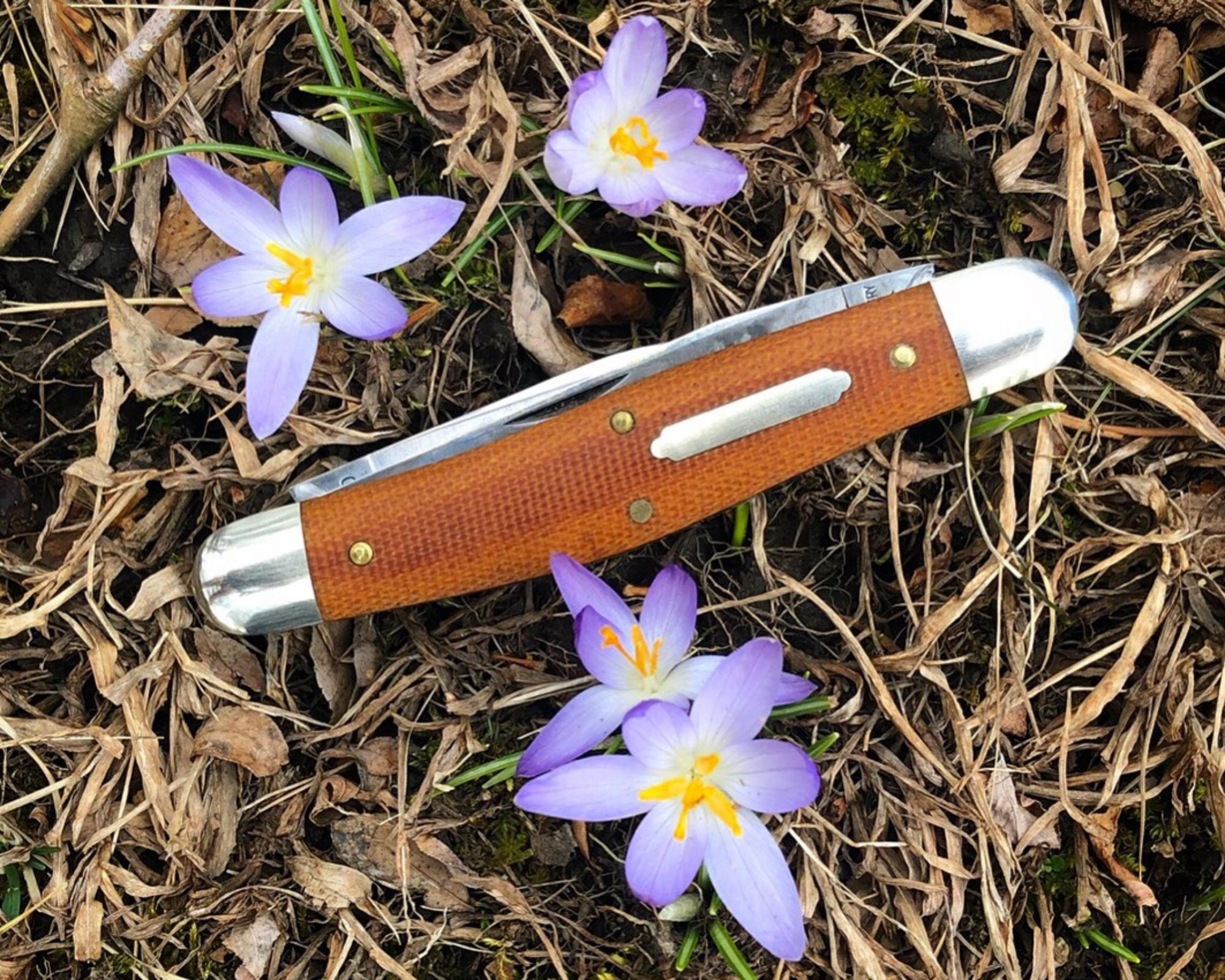
History of the GEC Waynorth Lambfoot: A Classic British Pattern Finally Brought to American Production

Special Factory Assembly #93 Lambfoot for Charlie Campagna under his Waynorth Cutlery brand

Foreword

Great Eastern Cutlery manufactured the Waynorth Cutlery #93 Lambfoot in 2019, and since then I have planned to write an article on the history of this unusual slipjoint pattern. In this article I will describe the pattern, its possible history, and why the Waynorth version is special. I hope itโ€™s an enjoyable and interesting read, but I want to stress and make clear that the content of this article should NOT be taken as absolute historical fact but rather as educated conjectures. Most of the points in this article are based on posts in the Guardians of the Lambfoot thread on BladeForums, and you can find links to specific posts I’ve referenced at the following links: 1, 2, 3, 4, 5, 6. If you would just like to see the knife in question check out the video below.


What is a Lambfoot knife?

The Lambfoot is a knife that not many in America are familiar with, and that can seem a little vague in its definition; so what is it? The Lambfoot is defined primarily by its blade shape. It has a straight edge, with no belly (before sharpening / wear). The spine is straight, but angled slightly downward from the handle toward the tip. The main spine section comes to a rounded angle that connects a smaller, also straight, spine section to the tip. Aside from the blade, a Lambfoot knife usually (but not always) has a swayback type handle. That means that the butt of the knife sets out of center with the pivot to the spring side. The Lambfoot also seems to most often be a single bladed knife, though there are multi bladed examples that can be found. So considering all that, the Lambfoot is similar to a harvester, pruning, or cotton sampler knife with a more slender blade and (typically) more slender handle.

A comparison of sheepfoot adjacent blade shapes. Click on the image to learn more about the different shapes.

What are the origins of the Lambfoot knifeโ€™s name and design?

The origin of the Lambfoot’s name and design is murky and difficult to nail down definitively, but there are a few things that can be guessed at with some research. First, the pattern seems to have emerged in the mid to lade 19th century. There are no obvious examples of the Lambfoot in Smith’s Key 1816, an industry pattern catalogue. That said, there are some knives that seem to be Lambfoot predecessors that blur the line between Sheepfoot, Wharncliffe, and Lambfoot. Another indicator that the pattern didn’t develop until the late 19th century is that it didn’t show up in America after many Sheffield cutlers immigrated to New England in the 1840s-1860s, which I’ll discuss further later in the article. Manufacturer catalogues from the late 19th century begin to show Lambfoot knives, and their representation in catalogues becomes widespread in the early 20th century. Around this time the cutlery industry in the UK saw many trademark infringement lawsuits and both the design, as a possible modification of the sheepfoot shape, and the name could have been an attempt at marketing and product differentiation. Some evidence for this is the commonness of Lambfoot knives having a stamp or etch on the blade announcing it as a “Real Lambfoot Knife”. Specifically, it might have been called the Lambfoot because it can be seen as a more slender Sheepfoot, therefore playing on the fact that a lamb is a juvenile sheep. While these are some of the possible reasons for the development of the Lambfoot name and design, it seems the specific origin of the name and pattern have been lost to history.


Why is the Waynorth Lambfoot from GEC so special?

So, why did Great Eastern Cutlery’s version of the Lambfoot knife make such a splash? It was one of the most anticipated and sought after knives in GEC’s history, which is full of highly anticipated and sought after knives. It was produced alongside a normal run of a new pattern for GEC, the #93 Ramfoot, as a Special Factory Order for Waynorth Cutlery. Waynorth Cutlery is the new brand created by Charlie Campagna. Mr. Campagna is the mastermind behind the TC Barlows, Harness Jacks, and other great SFOs that have helped to skyrocket Great Eastern Cutlery’s popularity. Considering its popularity in the UK, it might come as a surprise that the Waynorth Lambfoot seems to be the very first factory produced Lambfoot knife made in America. Although I’ve heard there might have been some knives made in America that had blades that toed the line toward being a legitimate Lambfoot, I can’t find an image showing an actual definitive example. So after around 100 years of existence the Lambfoot pattern finally made its debut, American style.

GEC’s reproductions on top and bottom, with the Sheffield J. Rogers & Sons Lambfoot. Thanks to Randy Bell for the picture!

Why didn’t the Lambfoot show up in America till now?

So, why did it take so long for an American company to make their version of the Lambfoot knife? As I mentioned earlier, one reason may be that many of the cutlers who founded the early American knife manufacturers immigrated to the United States in the mid 19th century, and the Lambfoot wouldn’t be “invented” or come to prominence till the late 19th and early 20th century. Meanwhile, the many blade shapes that became popular in America (Spear Point, Clip Point, Pen, Pruner, and Sheepfoot) had already been well established by the time the American cutlery industry was founded. Another barrier that may have kept the Lambfoot from being introduced into the U.S. market was the “McKinley” Tariff Act of 1890. This legislation brought the tax on imports to the U.S. to ~38-49% on average, and would have pushed Sheffield / U.K. manufacturers to turn away from the American market. This turn away from the U.S. market is also likely why the Lambfoot knife can be found in Australia (especially considering its high numbers of sheep and agricultural workers), and even somewhat in Canada, both once U.K. colonies. Finally, curved edges are more useful in skinning, hunting, and general outdoors / wilderness tasks. These types of tasks would have been much more common in America at the turn of the 20th century, when much of the country was still wilderness (whereas much of the U.K. was urbanized or farmland). Also, hunting was (and remains) much more common in the U.S. because there is more large game in the Americas. Additionally, hunting is illegal in many places in the U.K. because of an interesting history of the game being owned by the royal family and aristocrats. So, historical trends of industry, legislation, recreation, and immigration all seem to have likely played a part in the lack of Lambfoot knives made in America.

Case Trapper, Waynorth Lambfoot, Tidioute TC #15, Spyderco Native 5

Conclusion

The Waynorth Lambfoot has become one of my favorite knives. In fact, it was one of my most carried knives of 2020 and has become a great user. It has also inspired me to look into U.K. made Lambfoot knives and, although they seem somewhat difficult to get from U.S. sellers, I hope to add one to my collection in 2021. I have also enjoyed researching the pattern’s history, as it’s always a pleasure to see how closely the story of knives weaves into the overall current of history. I hope you’ve enjoyed this look at the Lambfoot knife.


Afterword

This article has been a long time coming. I have had several people request an article and / or video on the pattern, and I hope I’ve done the requests justice. Much of the information behind the content of this article was found in the Guardians of the Lambfoot thread on BladeForums, as well as a little on All About Pocket Knives. I greatly appreciate all the knowledge that can be found on those sites and the help I’ve received from members over the years. That said, the “Guardians” thread has over 46,000 replies and counting. It is extremely difficult to keep up with if you don’t spend significant time on the forums. There is an index post, but it also contains dozens if not hundreds of links with only headings and no descriptions. So for the vast majority of knife enthusiasts who don’t visit the forums, let alone spend significant time following and searching through threads, there are real barriers to accessing the knowledge surrounding this Lambfoot pattern. Whether that information is historical fact or educated conjecture, either way I think people are interested and have a desire to consume the info. One of the chief reasons I wanted to publish an article on this subject is because there really are few sources of information online about the Lambfoot, as well as other traditional knife subjects, other than threads on the forums. One of the chief reasons I publish articles and videos overall is to share knowledge with the people who don’t visit those sites. I personally believe that sharing knowledge, or even “conjecture” as this article contains, outside those sometimes insular groups can only be beneficial to the overall knowledge of, enthusiasm for, and interest in traditional knives. I hope this article is enlightening and helpful to you, and I appreciate you reading!


I sincerely thank you for your time, support, and interest! Don’t forget to tell your friends about KnifeThoughts.com, subscribe via email, and share this article on social media. You can find Knife Thoughts on YouTube where I have hundreds of knife videos, as well as on Instagram and Facebook!

How to Buy Great Eastern Cutlery Knives in 2021 and Beyond

Great Eastern Cutlery has exploded in popularity in the last few years, and in turn the demand for their knives has skyrocketed. This growth in demand has made it difficult for some to purchase the knives they’d like to when they’re released. In this article, as a companion to the video below, I’ll give you some tips on how to successfully purchase GEC knives in 2021 and beyond.

First off, I understand the frustration that comes with buying GEC knives. If you don’t reserve them as soon as they’re announced then you have to go the route of a “drop”. A drop is when the knives are released for sale on a dealer’s site either randomly or at a previously announced date and time. Either way, the knives often sell out within minutes of being available. Then, if you can’t get the knives on the primary market, they’re invariably significantly more expensive on the secondary market. This past year I have missed out on some of the knives I’ve wanted, which hasn’t happened much until recently. So I really understand how unpleasant it can be to feel like you don’t have access to the knives you want.

That said I don’t think GEC or the people who run it, in particular Bill Howard, are intentionally restricting supply to increase demand as some have suggested. Great Eastern Cutlery is a small company that works on a modified lean manufacturing style. That means they produce small batches of high quality products in a wide variation, with little inventory and only the raw materials necessary for upcoming batches.

A comparison of sheepfoot adjacent blade shapes. Click on the image to learn more about the different shapes.

Why do they do it this way instead of making huge drawn out batches of the most popular patterns? Well, I can’t speak for GEC’s management, but I can give you some of my guesses. I think that these small batches allow for higher attention to detail on each pattern. I also think smaller batches allow GEC to offer a much wider variety of pattern types. Even if they did focus on large batches, I’m not sure they’d be able to fill demand for the hottest patterns.

So, if they’re not likely to make enough knives in the sought after patterns to fill demand, whats the best way to ensure you get the knives you want?

First, you need to know what knives are coming out well ahead of time. If you don’t know about a knife until it’s for sale at dealers, it’s not very likely you’ll be able to get one. GEC puts out a production schedule on their website at this link. However, news of upcoming knives often comes out elsewhere before it is officially announced by Great Eastern Cutlery. For a long time the best place to hear about upcoming knives first was on BladeForums in the Traditional Knife Subforum, and specifically in the Let’s Talk GEC thread. Recently, news of upcoming releases has come out just as quickly on traditional knife Facebook groups. In particular, I help administrate the Great Eastern Cutlery Club group and I think it’s one of the best places to discuss GEC in general. News of upcoming patterns is usually the hot talk, so just follow along with one or both of these channels and you’ll be ahead of the curve.

Once you know of an upcoming knife you’re interested in, the best way to ensure you’ll get it is to reserve one with a dealer. I have been reserving knives by email for years through various dealers, and it usually is a relatively easy process. I’ve had positive experiences with many of GEC’s dealers but I most often reserve from Blue Creek Cutlery or CollectorKnives. Blue Creek Cutlery, like several GEC dealers (a list of which you can find at this link), does reserves by email. CollectorKnives has their own system that uses an app called Telegram to notify followers when a new knife is up for reserve. While those are the dealers I most often reserve knives through, I suggest contacting any you’ve purchased from in the past. If you haven’t purchased from any yet, just reach out to several dealers and start a correspondence with those who seem to fit your style.

If you’re not able to reserve a knife, the next best option is to try to snag one on a “drop”. As mentioned previously, these drops tend to sell out quite quickly. There are a relatively large number of dealers, so each only gets a small number of each knife. The exact number depends on the overall run, but recently it’s been between 5 and 25 (if what I hear is accurate). So you won’t be able to randomly stumble upon the knife on a dealer’s site; you’ll have to have the purchase planned. That said, thereโ€™s an argument to be made that drops are more fair than reservations because it does away with the possibility of long term or high spending customers receiving preferential treatment. If I have to go the route of a drop, I most often buy from KnivesShipFree or Tradtional Pocket Knives / C. Risner Cutlery. I am most familiar with them and have always gotten great service, but there are a lot of good dealers who use the drop system. Whichever dealer(s) you decide to give it a shot at, I highly suggest you know when the knives will drop ahead of time by subscribing to their email lists and following them on social media. Even if you know when a knife will drop and get there just when they do, the dealer sites sometimes get bogged down in the massive traffic and it can become impossible to get through the checkout process. That said, it’s better to get a knife in a drop than to have to go the secondary market route.

If you miss out on reserves and drops, the last option is to buy from an individual rather than from a dealer. No matter how you go about this, you should be prepared in most cases to pay more than the price that dealers charged. Many GEC enthusiasts have decried the secondary market and so called “flippers”, or people who purchase knives with the sole intent to resell them for profit. Certainly there are people out there who purchase knives without much interest in the knife itself and with profit as the goal. Still, I think there are more people who purchase a knife because they think they’ll like it, then for whatever reason decide to sell it and follow the market price. That said, lots of fair deals can still be found. For a long time the BladeForums Exchange was the place to find those deals, but that has changed somewhat in recent years. Now I think the best place to find reasonably priced knives on the secondary market is in Facebook groups, like the previously mentioned Great Eastern Cutlery Club or others like it. Aside from keeping an eye on the groups and BladeForums, every now and then a knife can be found on eBay or Instagram but much less frequently. The best things to increase your chances of finding a good deal on a secondary market knife are vigilance and patience.

I understand the frustration many feel when attempting to buy GEC knives, and I hope this article is helpful. In the last few years I have seen the massive growth in interest and demand for Great Eastern Cutlery made knives, and I have felt how it can sometimes dampen the enjoyment in trying to get those incredible knives. I want to help make it easier for people to get the knives they want, and to lower the learning curve for buying these sought after knives. Here’s hoping you get all the GEC’s you want in 2021 and beyond!

I sincerely thank you for your time, support, and interest! Don’t forget to tell your friends about KnifeThoughts.com, subscribe via email, and share this article on social media. You can find Knife Thoughts on YouTube where I have hundreds of knife videos, as well as on Instagram and Facebook!

Making Serrations Disappear; Modifying a Spyderco Caribbean

I recently picked up a Spyderco Caribbean at a good price. It was about 40% off on what seems to have been an impromptu sale by a big online knife dealer through a much bigger online retailer. I wanted the plain edge version, but only the fully serrated was on sale. So I went for it!

The finished product with a Buck 119 I did some edge work on at the same time

The Caribbean is a knife I’ve had my eye on for a while. Iโ€™ve wanted to try LC200N steel as Iโ€™ve heard good things about itโ€™s wear resistance versus the H1 steel Spyderco previously used on their Salt knives. I wanted a good knife for around the water (fishing, canoeing, boating, swimming, etc.), and the Caribbeanโ€™s highly rust resistant steel and accidental stab deterring sheepfoot blade made it a great choice. Plus the handle design is nice and simple in shape but loud in aesthetics, which Iโ€™m a fan of on both accounts. Finally, it has the compression lock which I find to be reliable and easy to use. Seems like a recipe for success, right?

The Caribbean’s design gives it a pretty recognizable outline

Well, I got it and at first I thought it was great! I havenโ€™t had many fully serrated knives, but it cut through some sunflowers really well. Then I noticed the edge had come with some serious burrs. I had some household cardboard to cut, so I put it to work. Mind you, Iโ€™m not talking a full day, or even hour, of breaking down cardboard; more like 4 or 5 boxes. To my shock and dismay, the edge showed all kinds of damage after just that initial use. It had big rolls that almost turned into chips, and it even seemed to still have the burr (and no, I didnโ€™t hit any staples). I suspected it had come with an edge that was burnt in the sharpening process, therefore ruining the heat treatment, and also possibly just too thinly ground. So after just a day of carry I decided to send it in to Spyderco.

Spyderco worked on it and another knife, and got it back to me in a reasonable amount of time. If youโ€™re interested in the full story on that, check out the video above. Unfortunately, I noticed right away that the resharpened edge of the Caribbean seemed off. Not only was it overly sharpened, so that the points of the serrations were rounded off, there were still some of the rolls left and it had burrs (leftover from before or new, I donโ€™t know). I have to say, I was rather disappointed. I can sharpen serrations with the tri-angle stones from the Sharpmaker, but I canโ€™t fix large rolls and damage to the edge. If every time that kind of damage happens, especially if it happens as easily as it seemed to the first time, Spyderco has to take off this much of the serrations then Iโ€™m not sure serrations are for me. I wasnโ€™t sure what to do, but I ended up deciding to take matters into my own hands.

Rounded serrations and leftover edge issues after a sharpening at the factory

I set upon turning it into a plain edged knife. I knew it wouldnโ€™t be easy or pretty, but it was to be a user and Iโ€™ve done knife modifications before. First, I used a file to take out as much of the serration ridges as I could and shape the edge. I got the edge shaped, but decided I needed a little more power to work out the serrations completely. So I used a dremel with a sanding wheel (on a slow speed and frequently dipping the blade in water, to keep it cool) to fully flatten the serrations. Finally it was time to sharpen, but that turned out to be no small matter either. Because it was essentially a chisel ground edge by necessity, it took some work getting the angles set and the apex created. Once done it turn out to be, although not great looking, entirely practical and usable. Even though it’s not a professional quality modification, it will make the knife more usable for me and I am happy with that.

So, do I suggest you do this? Absolutely not. It, obviously, voids the warranty (for what that’s worth). If I really wanted a plain edge Caribbean I would have been much better off just paying the extra 40% for it… but whereโ€™s the fun in that?

I sincerely thank you for your time, support, and interest! Don’t forget to tell your friends about KnifeThoughts.com, subscribe via email, and share this article on social media. You can find Knife Thoughts on YouTube where I have hundreds of knife videos, as well as on Instagram and Facebook!

How to Pick the Perfect Knife for YOU!

People often ask me for knife recommendations, and I’m always happy to oblige. It gives me a legitimate excuse to pour over all the incredible knife offerings available to us in this golden age of pocket cutlery. In this article I will share my method of how to choose the perfect knife for YOU!


Budget

The first question to ask yourself is how much you want to spend on a knife. Knives come in all price ranges, from a couple bucks to thousands. As long as you stay within reason, you should be able to find a knife in your budget. Usually the upper limit is the focus, but I will give a recommendation of a lower limit of $7. There are some legitimately serviceable knives just above that bedrock price, but I haven’t found anything worth the price any lower and the options are sparse below $15. On the upper end, I think everyone has a price point past which the quality doesn’t increase enough to keep up with the cost. Everyone’s range is different, but I generally stay between $15 and $150 (with some exceptions down to $7 and up to about $225).

Knives of quite different price ranges: $225 ZT0561, $15 Kershaw Thistle, $7 Geralt

Intended Use

How you intend to use the knife is just as important as budget, because if you have the wrong knife for the job, the price won’t matter. You have to decide how you plan to use the knife; whether that’s as a wilderness survival tool, a work implement, a fidget toy, or anything in between. The uses for knives are unlimited, and it’s up to you to decide which are important to you in relation to this particular knife purchase and filter the choices accordingly.

Two knives with similar aesthetics but very different practical purposes

Aesthetic Preference

Practicality isn’t all that matters; if you don’t like the way your knife looks and feels you won’t be happy with your purchase. That’s why you should consider your own personal aesthetic preferences along with the practical characteristics of a knife. One of the main aesthetic choices for me is modern versus traditional. I enjoy both types of knives, but I more often buy traditionally styled knives. For you it could be tactical versus practical, or flashy versus subdued, or any number of other spectra within which knives fall.

A slipjoint, a double edged automatic knife, and a one hand open locking knife. All of these are legal some places, all are illegal some places… as silly as that might be!

Legal Considerations

Finally, the most unfortunate consideration of what knife is right for you are the relevant legal restrictions. Many places have automatic knife laws, blade length laws, laws regarding the locking mechanism, and even the edge configuration. I highly suggest looking into your local knife laws before making a purchase. There are several ways to do this, but one good source is the American Knife and Tool Institute.


As you have probably surmised, a lot of individuality goes into choosing the right knife for you. That’s one of the best parts of the exercise; it gives you the opportunity to express yourself in a meaningful but practical way. Although the method for choosing a knife I present here is vague, I hope it provides a useful framework in your search!

If you are planning to buy a new knife on Amazon, consider doing so through my affiliate store. It doesn’t cost you any more than buying through Amazon normally, and it helps support this blog and my other Knife Thoughts content. I appreciate your support either way!


I sincerely thank you for your time, support, and interest! Don’t forget to tell your friends about KnifeThoughts.com, subscribe via email, and share this article on social media. You can find Knife Thoughts on YouTube where I have hundreds of knife videos, as well as on Instagram and Facebook!

How to Build a GREAT Every Day Carry for Under $100

In this article I will recommend to you the best gear for building a complete, functional, high quality every day carry setup for under $100. All of the gear I recommend here I have used and found to be a good value and up to the tasks of EDC. Part of what makes building a complete every day carry fun is expressing your own tastes and preferences in the gear, so I’ve given at least a couple options in each category. I didn’t include every possible item that could be considered part of an EDC setup (E.g. wallet, keychain, pry tool, etc.) but stuck with the most essential tools. No matter which option within each category you choose, you should be able to build a complete and really effective every day carry setup for a budget friendly price.


Knife

Ah, my passion. I am a knife enthusiast through and through, above and beyond my enjoyment of other EDC tools. So what knife(s) do I recommend for a high value / low cost every day carry? I don’t think you’ll be surprised.

Some (well used) top tier budget knife options

If you want a modern knife, with one hand opening and a lock, I recommend the Ontario Rat 1. Classic design, consistent quality control, and proven utility come together in an extremely high value package in the RAT 1. There’s a reason it’s, almost for sure, the most recommended modern knife on the market. I have had several of these, I give these as gifts to family and friends, and I’ve only had good experiences myself and gotten good feedback from others. For about $25 you have a great all around knife.

Whether due to local laws, your aesthetic preference, or a desire for more tools, another great option is the Victorinox Huntsman. For less than $35 you get an incredibly well made knife with two blades, a saw, scissors, screwdrivers (which can pry), bottle opener, can opener, awl, corkscrew, tweezers, and last but not least (maybe…) a toothpick. It’s an extremely versatile tool. Of course, Victorinox has a huge variety of models with different tool combinations. Another I think makes a great EDC is the Pioneer, if you don’t need the scissors and saw.

If you’d like to go traditional but don’t want, or need, all the extra tools I recommend the Case Sod Buster JR. It’s not the fanciest looking traditional out there, but it doesn’t sport the abysmal unpinned shield that most Case knives have and it’s an extremely utilitarian and proven design. For under $30 you get an American made knife with a great warranty that will last a lifetime.

Finally, some prefer the dependability and simplicity of a fixed blade. There are a lot of great budget fixed blades on the market, but nothing can beat the Mora Companion. For around $15 you get a knife that is extremely strong and durable, cuts well, has a great design, and comes with a really nice sheath (for the price). The Companion is just an all around winner, and any knife or EDC enthusiast should have one.


Flashlight

I have to admit that I have yet to nail down my ideal flashlight EDC. I have carried several different lights, but have carried a FourSevens Preon more than anything else combined. I’ve tried it in pocket, on my keychain, and in my bag. Unfortunately, the newer and currently only available version of the Preon is too expensive to include in this article. I’m going to give a recommendation for a light for each type of carry: Bag, Pocket, and Keychain.

A headlamp option is very functional

For bag carry, I think a flashlight that doubles as a headlamp is extremely useful. A headlamp is much more practical than a handheld light when camping and working. I have been using the Wowtac A2S, and think it’s a good value. It seems well made and sturdy, has a really useful moonlight mode, can be super bright, and comes with a nice headstrap. The only downsides are that it doesn’t come with a pocket clip and the beam could be wider for general use. Still, at under $30 I wouldn’t hesitate to buy again. If you’d prefer a model with a clip and forward facing (rather than 90 degree) head, and don’t need the headlamp capability, the WowTac A1S is a good option for the same price.

For pocket carry I like a thin light. Flashlights that use 18650 batteries are more powerful and longer lasting, but I think AAA based lights make for less obtrusive carry. With that in mind, I’d recommend the Lumintop IYP365. It is relatively bright, has a great look, and is easy to carry. It doesn’t use rechargeable batteries, but it’s less expensive than the above options that do, at about $20.

There are a lot of really small, bright, easy to use keychain flashlights… but many of them have a flaw that keeps me from recommending them; their charging ports are covered only by a silicon plug. In my experience these plugs come loose easily, and render the light’s water resistance effectively null (plus they get in the way of holding the light). So I’m going to recommend the Olight I1R 2. It doesn’t have a clicky interface, which is a downside, but the twisty is nice and straight forward to use. The charging port is legitimately covered by screwing down the body. It has a low and high mode, which is all you need on a keychain light. For $15, it’s a good value.


Pen

In this category my main recommendation is an easy choice: the classic Fisher Space Pen. This is a pen that many have recommended, and for good reason; it works, all the time. I have used these through college, at work, in the outdoors, etc. and have always been happy with their performance. In fact, I’m always amazed at how long the cartridges last. At about $25 for the clipped version, which I much prefer, you’ll get a pen that will last a lifetime.

A good clip might bend, but it won’t break easily.

I will say though, the Zebra F-301 is a solid secondary choice. They have a nice look and solid feel with the stainless steel body, they have a strong clip, and they write well. You can get 12 for less than $20, so it might be a better choice if you tend to lose pens.


Notebook

Every now and then I decide it is more economical and convenient to just take notes electronically, and every time I do I stop taking notes. For some reason, a physical notebook just works better. I have used a huge variety of notebooks, and there are a lot of good ones out there.

I’m a big fan of Rite in the Rain

For a pocket carry notebook, I much prefer the Rite in the Rain Mini Stapled Notebook. They are pretty much completely weather proof, so you don’t have to worry about them turning to mush if you forget them in a pocket (or just get a little too sweaty). They have a universal pattern rule that makes them useful for any kind of note taking, including bullet journaling. Plus, you get 3 for about $9 so you can write to your heart’s content and not worry about filling too many.

If you’d rather have a larger notebook that you carry in your bag, I like the Moleskine Classic. It’s more expensive than some others on the market, and maybe kind of cliche, but I haven’t found a better option. At about $10 you do get a lot more pages and a classier feel. However, if you don’t care about looks and just want a notebook for in your bag you can always go with a $6 5 Star Composition Notebook (which can be bought for less in big box stores).


Lighter

I don’t personally carry a lighter in my true EDC, thought I do carry one in my bag every day. I just don’t need a lighter that often, and always just remember to bring one if I’m going camping or something like that. That said, I do think it’s a good idea to have a lighter around, even if it’s just in your bag or car.

A lighter in my EDC pouch

My recommendation for a lighter isn’t going to please those who are looking for something to add to their pocket dump pictures for Instagram, as it’s all function and no form; the Bic Mini. Why do I recommend the humble Bic? It’s small and easy to carry (fits with room to spare in the 5th pocket of most jeans), pretty much always works, and the fluid won’t evaporate. Plus, you can get 5 for well under $10.

Still, I don’t want to completely snub the classic Zippo. I don’t use a lighter frequently enough to keep the classic fluid from evaporating, but Zippo recently came out with a butane insert and rechargeable arc insert that mitigate that issue. If you’d rather have something that looks better (and there’s nothing wrong with that) or would rather have something reusable, the Zippo is tough to beat. I do think there’s something to be said for not throwing a chunk of plastic away, probably to find its way to the ocean or a landfill or something, every time you use up a lighter. Thankfully I don’t use them up often at all.


The links in this article are Amazon Affiliate links. That means that if you decide to buy any of the products through these links, I will get a small percentage of the sale. It does not charge you more, and they are the same products (generally) you’d find if you searched on Amazon. I encourage you to look around online for the best deals, but I do appreciate your support via the affiliate links. I was not paid or compensated to recommend any of these products.


P.s. I am not knowledgeable on watches, but many EDC enthusiasts appreciate them. If you just need something functional, I highly recommend the Casio F108WH. I purchased one over 3 years ago for a hunting trip expecting to lose or break it, but it has taken all kinds of abuse since then (from teaching martial arts to white water rafting) with no issues. For $15, it’s a great value.