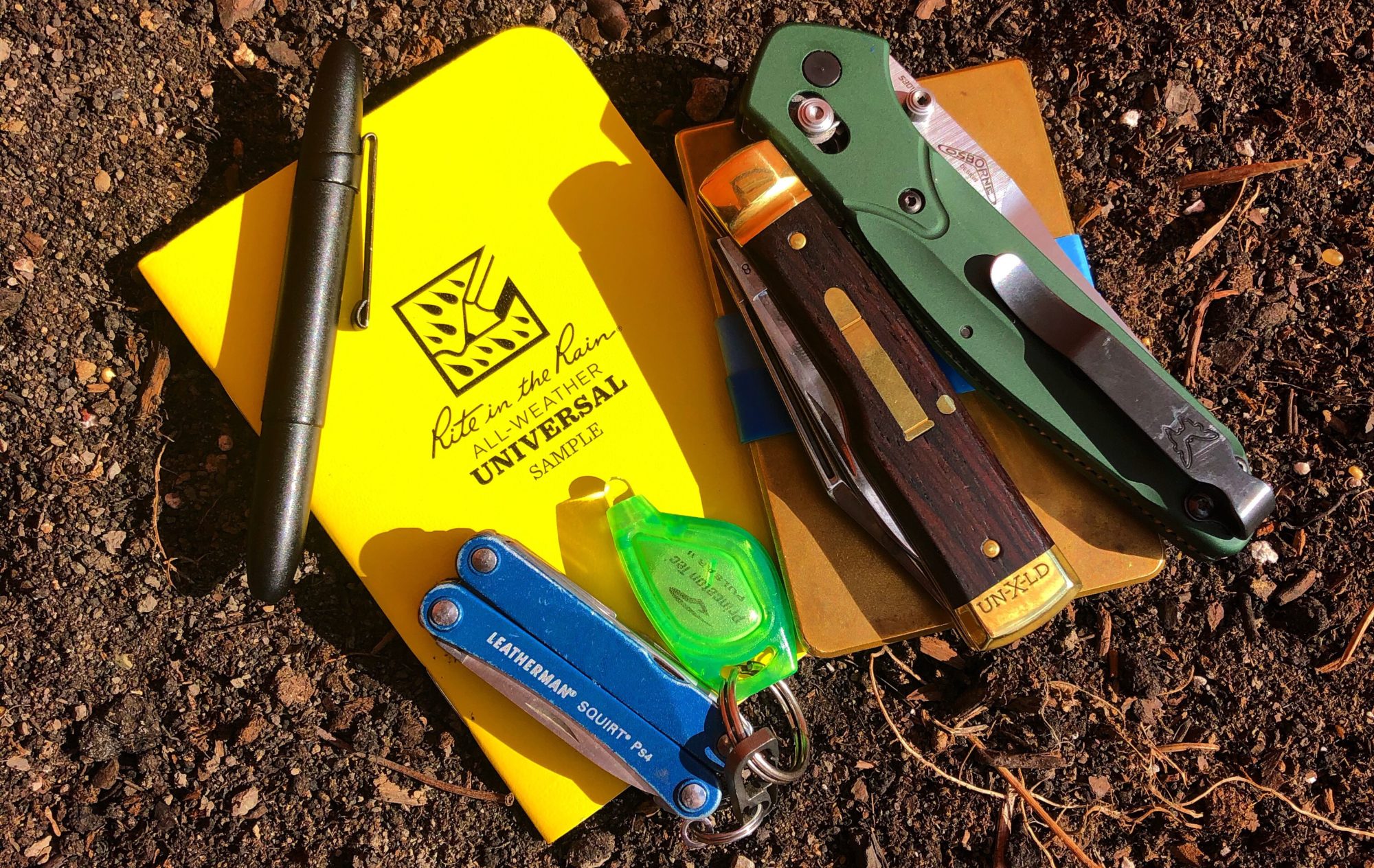
Have you ever picked up your EDC knife for the day and realized it was duller than a trip to the DMV? Sometimes you don’t have time to break out the full fixed angle fancy sharpening system and sit down for a laborious labor of love to get that perfect apex. Sometimes you just want to get your knife back to doing what it’s made to do; cut stuff. Well I have some great news for you! Not only can you serviceably sharpen a knife without specialized tools, you probably have some options for achieving a perfectly usable edge just lying around.
Your Cup of Coffee
No, not the disposable cup from your local mega-chain coffee shop. Your normal every day stained from years of use ceramic coffee cup can actually be used to sharpen. Now, you’re going to be turning the cup upside down, so I suggest one without coffee in it. The bottoms of most ceramic mugs have a ring of exposed medium-ish grit ceramic. This ring can be used very similarly to a sharpening stone or rod. Simply draw your knife’s edge across the exposed ceramic grit at the appropriate angle until you reach an acceptable apex. Make sure there aren’t any oversized pieces of grit in the area you use so as to not create any edge damage, and make sure to use light pressure and a consistent angle. You’ll have a very passable edge and will be ready to pour your favorite brew!
Your Drive to Work
Now, to be clear, I am NOT suggesting you sharpen your knife WHILE driving. That said, when you get in the car to warm it up in the morning you can use the top edge of your window to sharpen. Similarly to a coffee mug, most car windows have an exposed area of fine-ish grit along the top edge. In my experience the grit on this top edge of car windows is significantly finer than that on coffee mugs. So use the same method, but it might take a few more passes and you might be able to achieve a little bit finer edge. Just make sure you do it sitting inside the car, otherwise you might look a little too nefarious; waving your knife menacingly in the window of an empty car. This can be a great way to keep a sharp edge even when traveling!
Your Essential Raiment
If you just need a quick touch up to bring your edge from sharp to razor sharp and wear a leather belt you have a strop at your constant disposal. While it might not make a truly dull knife sharp, a leather strop can be a great way to keep your edge sharp. Even a leather belt can be used as a strop, though I generally recommend using the back / inside side of the belt to avoid any scratches showing. Also, the inside of the belt is sometimes a rougher finished leather, which can be more effective as a strop. To use the strop, find the correct angle for the edge and pull the blade in an edge trailing orientation across the belt with light pressure along the whole edge until the knife is back to your preferred sharpness. If you want to get really wild with it you can even put a very small dab of toothpaste on the leather and smear it around to an even and very thin coating on the area you’ll use as a strop. The toothpaste will provide a little bit of polishing action, not to mention a pleasant aroma.
Dull knives don’t have to be a constant frustration when you’re short on time or specialized tools. With a little ingenuity, you can sharpen your knives using everyday items you already have around the house. Whether it’s a ceramic coffee mug, the top edge of your car window, or even a leather belt, these household items can be employed to achieve a usable edge on your knife. Just remember to use light pressure, a consistent angle, and be aware that these methods should be used as backups when a dedicated sharpener isn’t available. With these simple tips, you can get your knife back to its cutting best in no time.
I sincerely thank you for your time, support, and interest! Don’t forget to tell your friends about KnifeThoughts.com, subscribe via email, and share this article on social media. You can find Knife Thoughts on YouTube where I have hundreds of knife videos, as well as on Instagram and Facebook!
I have always enjoyed flashlights, but over the last year or so I have really dived in and become an enthusiast. I remember stopping at the flashlight tables at the “Sports Show” (now the Great American Outdoor Show) with my dad when I was young and being awed at the array and power of the lights. While I’ve mostly always carried a flashlight and found them to be useful, only recently have I really taken the time to learn about them and what makes a good one. I’ve spent countless hours perusing r/Flashlight on Reddit and reading Budget Light Forums so you don’t have to. Below are four features I suggest when choosing a great every day carry flashlight.
Skilhunt M150; Mini Size, Many Features
1: Practical Emitter Setup
Flashlight enthusiasts place a massive emphasis on the emitter and optics used by their lights. I don’t think the average person looking for a practical user light has to worry about the minutia of bin and dedoming and other technical details (if you don’t know what those mean, good! You really don’t need to to get a great light). However, a good emitter setup can make a flashlight much more enjoyable to use.
Emitter & Optic Setups: Single Reflector, Single TIR, Quad TIR, Mule
There are a myriad of emitters, or LEDs, that are used in EDC flashlights. While there may be better options for specific use cases, you won’t go wrong with some of the widely recommended options. Namely; Nichia 519a (overall), Nichia 219b (tint), Samsung LH351D (flood), and Luminus SFT-40 (throw). Respective to the listed key characteristic, these are some of the best and most recommended LED emitter choices available in every day carry lights. I have used them all and think they all work great, just with different strengths. While there are other emitters that might beat those listed in one area or another, I think the above are great options to look for in your carry light.
As for the optic, the portion of the flashlight that directs the light from the emitter outward, I suggest a simple single emitter reflector. Flashlight enthusiasts love “hotrods” that have multiple emitters behind compact TIR optics, and these are definitely fun, but I don’t think the added brightness is worth the added heat and battery drain. For general daily use a single emitter, one of those listed above, will provide more than sufficient light. While a TIR optic with a single emitter does send out an extremely uniform beam, I find the hot spot and spill offered by a simple reflector optic to be more useful in more situations.
2: On Board Charging
On board charging, the ability to charge the light’s battery without a separate charger, is a near must have on an EDC flashlight. At first I was actually staunchly against on board charging. Most lights with on board charging have a silicone port cover, and I didn’t trust them to be water proof. However, I have now used lights with on board charging (with or without silicone ports) and have had no issues with water damage.
On Board Charging Saves Space
The fact is it is just supremely convenient to be able to plug your flashlight in and charge it without the hassle of added equipment. This is particularly true while traveling, when you might not want to or be able to bring a full charging setup and backup batteries. Most flashlights are now using USB-C, which is a common and familiar cord that’s used for many other electronics (soon iPhones also, I’ve read).
A couple other things to look for are standard batteries and interchangeable battery options. First, Some flashlights use proprietary batteries, which cannot be replaced with standard size batteries. While a proprietary battery isn’t a deal breaker in all cases, I think it is much better when a light can take a standard size battery (14500, 18650, and 21700 are some of the most commonly used and recommended sizes for EDC) in case you lose or wear out the battery your light came with originally. Second, some lights can take normal alkaline or NiMH batteries in addition to the commonly used Lithium Ion batteries mentioned about. Specifically, some flashlights that use 14500 lithium ion batteries can take AA and some 10440 battery lights (smaller than I recommend for EDC) can take AAA. This feature can be useful if you find yourself somewhere where you can’t recharge your light but have access to the more common alkaline options, like when traveling or camping.
3: Usable Clip
A clip can make or break any tool you carry every day, and the clip on your flashlight is no different. Unfortunately, a significant number of flashlights are sold with sub par clips that make them less convenient to carry.
Two good single direction clips on the outsides, and two acceptable two way clips on the inside
One common attribute that flashlights advertise as a feature is a two way clip. When done right a two way clip allows for the flashlight to be clipped bezel downward in your pocket and also bezel forward on the bill of a hat. However, this type of clip without a ramp in the bend at the bezel end can be very difficult to clip into your pocket intuitively. I also don’t wear baseball hats often, so I don’t find a two way clip to be useful but I understand many appreciate the feature. So, just make sure there is an up turned area that will catch the lip of your pocket and direct it under the clip if you buy a light with a two way clip.
Another common downfall of flashlight pocket clips is a general flimsyness. Try to avoid lights that use overly thin snap on clips, as these can often pull off or even snap.
Generally, a good every day carry flashlight clip is a simple and straightforward design that should look relatively similar to an EDC knife clip. While overly flimsy snap on flashlight clips are to be avoided, the truth is that the vast majority of lights use snap on or pressure fit clips unlike on knives where clips are almost always screwed on.
4: Straightforward User Interface
A good EDC light has a user interface that gives you the functionality you need without overcomplication. For most real daily use, there are only a few features I find to be commonly used: direct access to the lowest brightness, direct access to the highest brightness, a smooth or stepped ramp between low and high, and mode memory (the ability to turn on at the last used brightness). Many flashlights offer a strobe, but I don’t think strobe is a must have. Even if you need to use your light in a defensive situation I think direct access to the highest brightness would probably serve just as well as a dedicated strobe mode.
An enthusiast focused hot rod with Anduril 2 can be fun and make for a cool EDC pairing, but it definitely goes beyond pure function
Now, that’s not to say that the fancier user interfaces, namely Anduril (now on version 2), aren’t fun and interesting. I really enjoy the customizability of my Anduril lights, and you can certainly customize them to be simple as described above. That said, I think most people who buy a flashlight for EDC don’t want to have to program their light and wouldn’t gain much value from the added features.
Conclusion and Recommendation
Just like knives, flashlights can be a purely practical tool or an expression of one’s style. In this article I’ve endeavored to provide my recommendations for an every day carry light that leans toward the former, while still scratching that itch that we EDC enthusiasts have for coolness in our tools. My hope is that this article helps you to find the best light for you.
Wurkkos FC11; Budget Workhorse
That said, if you want a simple and direct recommendation, I would suggest the Wurkkos FC11 (Amazon Affiliate link). It is a great mix of all of the features I mentioned above in a budget friendly package from a well known brand. Whichever light you go with, don’t forget to go out and do good!
I sincerely thank you for your time, support, and interest! Don’t forget to tell your friends about KnifeThoughts.com, subscribe via email, and share this article on social media. You can find Knife Thoughts on YouTube where I have hundreds of knife videos, as well as on Instagram and Facebook!
If you follow Knife Thoughts you know I love a traditional knife. There’s just something about an old long proven pattern that hits me (and many others) the right way. The majority of traditional knives I have discussed have been of western origin; from the USA with roots in the UK or Germany, and some from other European countries like Italy and France. That said, knives are universal and there’s a whole world of knives and knife history out there to explore. That’s why I am really excited to see two traditional Asian knife patterns translated into modern every day carry knives in the Vosteed Nightshade and Civivi Ki-V Plus!
Vosteed Nightshade
The Vosteed Nightshade is a modern knife that emulates the Shilin Cutter. The Shilin Cutter is a pattern from Taiwan. The pattern originated in the mid 19th century when a cutler named Kuo He created and subsequently popularized the design. The knife is designed with a downward canted leaf shaped blade that lends itself to gardening and other utility tasks, while the handle is a simple eggplant shape that makes it extremely ergonomic even in extended use. The original traditional version was a slipjoint, meaning it used spring pressure to hold the blade open and closed but did not lock, and typically had forged blade steel and buffalo horn covers with brass bolsters.
Unfortunately, the shop that originally made the Shilin Cutter no longer seems to be in operation and even imitation versions are difficult to find. Spyderco created a modern knife based on the Shilin Cutter in the Bob Lum designed Lum, but it is discontinued and now exceedingly expensive on the secondary market.
Enter, the Vosteed Nightshade. Vosteed is a company that I became aware of relatively recent because of their high value kitchen knives, but they also have several folding knife designs with more on the way. The Nightshade makes few changes to the design of the Shilin Cutter, but updates it with modern materials and construction. It has snappy and smooth one hand opening with a flipper and ball bearing pivot, a pocket clip, a liner lock, 154cm steel (a great mid range steel), and G10 handles. It also is just plain really well made, like I was genuinely surprised at how nice it is (not to mention the high quality metal box in which it’s packaged).
The designer, Yue Dong, was gifted an original Shilin Cutter and has used it extensively for camping and every day carry tasks, but designed the Nightshade to be an updated and upgraded version that would stand up to wear and tear. I have found it to cut extremely well so far, as it came very sharp and seems to have a nicely ground primary bevel, and honestly have just enjoyed flipping it (it’s very smooth). With a comfortable handle and a sturdy but slicey blade, I think the Nightshade is up to pretty much any EDC, outdoor, or general use task.
You can get the Nightshade at this link and use code KT5 for $5 off a Nightshade or KT20 for $20 off the Nightshade and Shark Bomb pry bar combo! I also suggest joining Vosteed’s Facebook group at this link if you get one of their knives, as it’s quite active and enthusiastic.
The Civivi Ki-V Plus is a modern folding knife that takes its design cues from the Kiridashi. The Kiridashi is a traditional Japanese fixed blade pattern. Like the pen knife in Europe and the United States, the Kiridashi serves as a small utility knife that was carried by the majority of people for everyday tasks. The Kiridashi has a straight, angled edge and is traditionally ground with a chisel primary bevel, meaning one side is ground and the other is left flat (other than the secondary bevel, or edge). This edge and grind style also lent the Kiridashi to shop work, like scoring wood and other such tasks. The traditional Kiridashi most often had a simple carbon steel blade and either a wooden handle or a skeleton, or plain metal tang, handle. While several companies are now offering modern renditions of the Kiridashi, I think the Civivi Ki-V Plus does about the best job I’ve seen of keeping the traditional design while adding modern materials and construction.
Now, the Ki-V Plus is actually an enlarged and modified version of the Ki-V (you can watch my video on it here). While I enjoyed the Ki-V and thought the designer, Ostep Hel, did a great job of keeping the traditional aesthetic I thought it could be improved with a different flipper tab design. Although the Ki-V plus doesn’t have the exact type of flipper tab I was imagining, I think it is an improvement over the original. I am NOT usually a fan of front flippers; I’m just not dexterous enough for them most of the time. That said, I’ve had a lot of fun flipping the Ki-V Plus and haven’t found any difficulty in opening and closing it in real use. The Ki-V Plus also adds a liner lock, whereas the original Ki-V was a double detent slipjoint. Even though I think the Kiridashi design does lend itself well to a slipjoint, the added size of the Plus version makes the liner lock a smart choice. However, I think a larger cutout on the front facing handle would make unlocking the blade a little more intuitive. Speaking of the larger size, the Ki-V Plus’s longer blade makes it feel like a knife better suited to working; still not necessarily hard use, but not relegated exclusively to lighter tasks either. While the Ki-V Plus doesn’t have the traditional chisel grind, the traditional angled edge still works great for all kinds of cutting tasks and especially those most common in EDC usage like opening boxes and cutting cardboard. I have had a lot of fun with the Civivi Ki-V Plus so far and have found it to be a very capable EDC knife.
Honestly, if you can’t get both, just go with whichever one strikes your fancy. Either way you’re going to get a well made knife. That said, I think if you do more gardening and food prep and outdoor tasks the Nightshade might be better suited for you while if you do more cutting cardboard and opening boxes and such the Ki-V Plus might be a better fit. Still, either will work suitably for most tasks. I enjoy both knives for their quality and materials, but what I really appreciate is how well both give homage to their traditional counterparts. I hope to see more and more of that respect for traditional patterns in the modern knife industry going forward, but for now I’ll just keep enjoying my Nightshade and Ki-V Plus!
Some of the links in this article are affiliate links. That means that if you follow the link and purchase something I get a small commission. It does not affect the price you pay, aside from the discount codes I offer, but it does help Knife Thoughts immensely!
I sincerely thank you for your time, support, and interest! Don’t forget to tell your friends about KnifeThoughts.com, subscribe via email, and share this article on social media. You can find Knife Thoughts on YouTube where I have hundreds of knife videos, as well as on Instagram and Facebook!
Clubs have always played an important role in the knife community, and one of the most curious examples is the Barlow Bearcats. This unusual club was created by Allan Trout for his “Greetings” column in the Courier-Journal of Louisville Kentucky. Starting in 1949 and going right up to the start of 1960 Mr. Trout penned countless amusing articles inducting members into the Barlow Bearcats and sharing their experiences surrounding barlow knives.
A Case Barlow next to a Mini Hunter
Membership in the original Barlow Bearcat Club was restricted to those who owned an original Russell Barlow. The Russell Barlow is often purported to be the first barlow made in America, starting in 1785, but there’s no question that it’s the knife that launched the barlow pattern to universal fame. In “Home Life in Colonial Days” Mary Earle said “The boy’s jack-knife was a possession so highly desired, so closely treasured in those days when boys had so few belongings, that it is pathetic to read of many a farm lad’s struggles and long hours of weary work to obtain a good knife”, which illustrates the value put on knives like the Russell Barlows. That said in 1920 a Russell Barlow cost $1 which, when adjusted for inflation, is only about $15 in today’s money. What a deal!
The Great Eastern Cutlery #77 Yankee Barlow
This re-imagining of the club will be open to anyone who owns any barlow. You can learn more about membership and apply at the page linked here and below. My hope is that the club grows into a fun new way to participate in the knife community. I love barlows, a barlow knife helped launch my love of traditional slipjoints, and I know countless others love barlows also… so I hope to see you in the Barlow Bearcat Club!
Very soon I will be sending out the first newsletter for club members. This will include some of the stories submitted by applicants, interesting details on the original club, and other various related thoughts and news. While I plan to go into more detail on the original club in the newsletter, I thought I’d leave you with one of my favorite lines from Mr. Trout’s column, which he wished upon the 100th member of the club; “May the keen edge of your interest last as long as the keen edge of your blade”!
How it feels to own two barlows!
I sincerely thank you for your time, support, and interest! Don’t forget to tell your friends about KnifeThoughts.com, subscribe via email, and share this article on social media. You can find Knife Thoughts on YouTube where I have hundreds of knife videos, as well as on Instagram and Facebook!
Great Eastern Cutlery is releasing another run of their #65 Ben Hogan pattern currently. Go ahead, do a google search for Ben Hogan… you’ll be scrolling for a long time before you come upon anything on the colorful character for whom the Great Eastern Cutlery #65 pattern is named. Unfortunately this unique player in American history has been overshadowed by the golfer, but Great Eastern Cutlery is doing their part to keep his story alive with their #65 pattern that carries Ben Hogan’s name.
Who was Ben Hogan?
Ben Hogan was one of the many larger than life characters involved in the heyday of Pithole. Pithole was one of the major epicenters of the early days of the oil boom in Pennsylvania and is nearby to Titusville, where Great Eastern Cutlery knives are made. The narrative comes down to us mostly from the semi autobiographical “The Life and Adventures of Ben Hogan, The Wickedest Man in the World”. This book details the many (supposed) exploits before and during Hogan’s stay in Pithole. Born in Germany in 1840, Hogan (originally Benedict Hagan) immigrated to New York and immediately began his notorious career by killing a scam artist who had targeted his father. From there he becomes a cabin boy then a blockade runner and even a full fledged pirate. Eventually he hears of Pithole and the oil boom and moves to take advantage of the already raucous environment. He puts on a strong man show, tries his hand at sparring and gymnastic lessons, opens a saloon, and claims to have been part of the notorious French Kate’s brothel business. By no means is this an exhaustive list of his feats and claims to notoriety, and I highly suggest checking out further reading (Explore ClarionPetroleum History). Finally, in a twist worthy of such an exceptional character, Hogan converts to Christianity, goes on an evangelical tour, and runs a soup kitchen in Chicago for the remainder of his life.
What is the Great Eastern Cutlery #65 Ben Hogan Pattern?
The GEC #65 pattern is a long slender jack knife that almost defies definition using traditional slipjoint nomenclature. It might be called an English Jack, due to its long slender mostly sleeveboard shape, but the irregular bolster calls that designation into question. The bolster, with its extension on the blade well side that almost covers the tang to create a sunken joint, is reminiscent of a Copperhead but the handle is just not shaped like a typical Copperhead. So it’s an unusual pattern. Great Eastern Cutlery has done several runs of the pattern including spear point blades and clip point blades, plus the Fish Knife with a scaler / degorger / bottle opener secondary tool. So far this run in 2022 has included three single clip point bladed versions (Osage Orange Wood, Jigged Red Bone, and Smooth White Bone) and a Fish Knife version with Tortoise Shell Acrylic covers. Both the versions I have came with interesting lanyards that are not something GEC has done before; an acorn bead for the Osage Orange and a whistle for Fish Knife.
They come with some interesting lanyards
Unfortunately, pretty much every #65 I’ve had (including 3+ from previous runs and 3 from this run) have had blade rap. Blade rap is when the blade over travels upon closing and the blade hits the spring, causing damage to the cutting edge. While I think it’s probably possible to make a knife of this long and slender shape without blade rap, it’s not a huge surprise that this issue rears its ugly (and all too common) head on the #65 pattern considering the greater momentum the blade has upon closing. So while I don’t plan to buy any more of the variations on this run of the GEC #65 Ben Hogan pattern, I still think it’s an interesting knife with a great namesake!
The blade rap is not at the typical place, the spring pin location, but at the belly
If you decide to pick up a Great Eastern Cutlery #65 Ben Hogan I highly suggest trying to get yours from Knives Ship Free using my Affiliate Link. Not only does it help Knife Thoughts, it’s also just a great place to buy knives (of all types, not only GEC)! That said, Great Eastern Cutlery knives tend to sell quick so you can check out my article on how to buy GEC knives and try at other dealers like Traditional Pocket Knives, Blue Creek Cutlery, etc.
I sincerely thank you for your time, support, and interest! Don’t forget to tell your friends about KnifeThoughts.com, subscribe via email, and share this article on social media. You can find Knife Thoughts on YouTube where I have hundreds of knife videos, as well as on Instagram and Facebook!