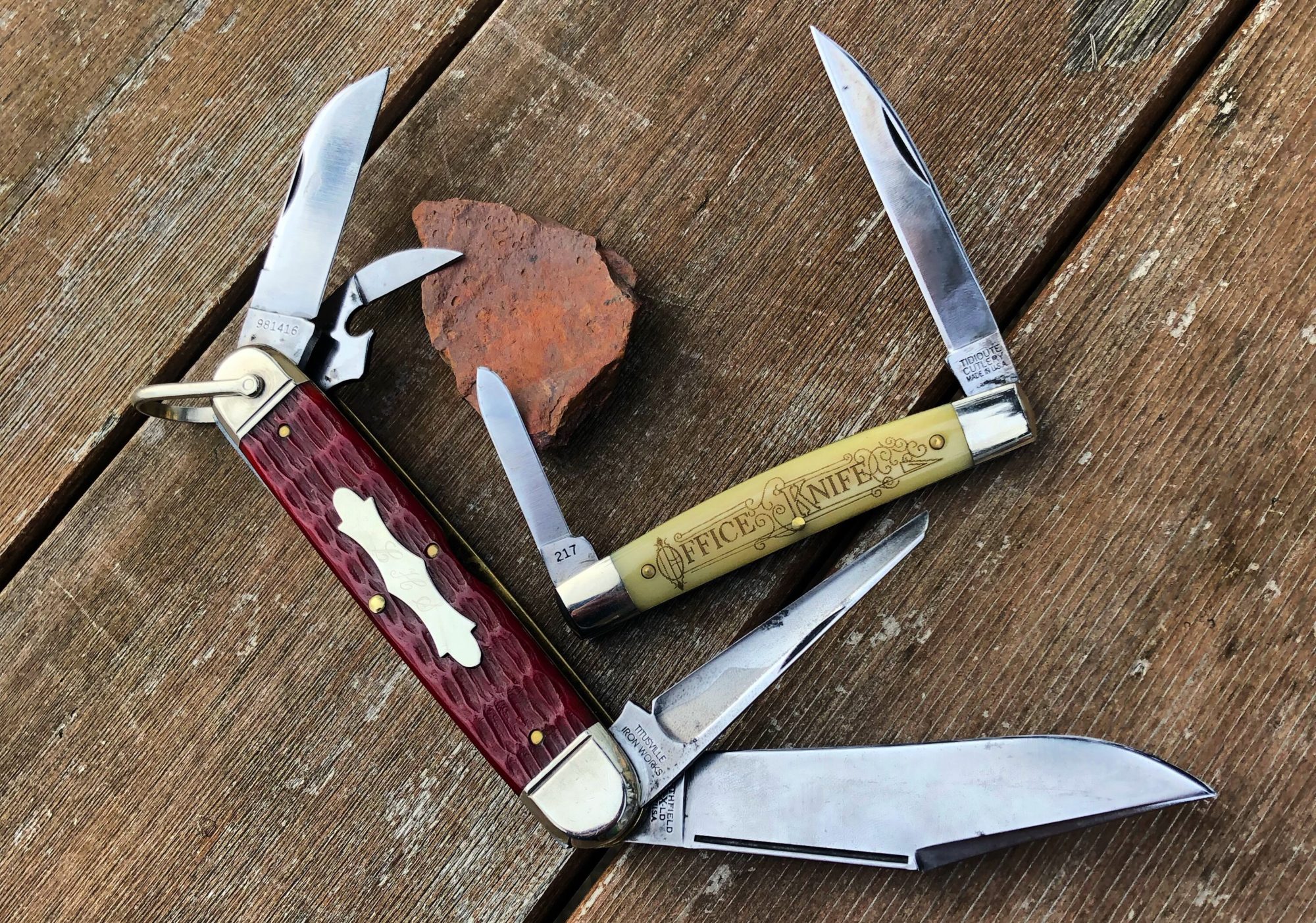
The “Rider by CC” and the Reemergence of the Harness Jack as Spurred by Charlie Campagna

The Rider by CC is the latest in a string of incredible Special Factory Orders for Charlie Campagna by Great Eastern Cutlery, and a classic Harness Jack.

TLDR? Check out my video on the Rider by CC and the Harness Jack pattern here!

Who is Charlie Campagna?

Charlie Campagna is a knife collector whose passion has helped spur the re-popularization of traditional knives. His special factory orders have contributed greatly to the reemergence of classic knife patterns like the Barlow (if you love Barlows, check out the Barlow Bearcat Club here!) and the Harness Jack. Whether on the forums or in person at knife shows, like the Great Eastern Cutlery Rendezvous, his generous sharing of knowledge and jovial yet reserved temperament has been a boon to the traditional knife community. Here’s a link to a great Q&A from VintageKnives.com in 2004, that might help to illuminate who Charlie is.

What is Waynorth Cutlery?

Waynorth Cutlery is the brand created and owned by Charlie Campagna. It is named after his BladeForums username, “Waynorth”. So far only three knives have been graced by the Waynorth Cutlery tang stamps; “Waynorth” arched over “Cutlery” over “Buffalo, NY” and on the reverse the classic “OIL THE JOINTS”. Those knives are the Lambfoot (GEC #93 pattern), Blackjack (GEC #86 pattern), and now the Rider by CC (GEC #86 pattern). Although Charlie did have knives made by Queen while Bill Howard (now founder / owner of Great Eastern Cutlery) was head cutler there, all of the Waynorth branded knives have been made by GEC. The Rider by CC is Charlie’s newest special factory order, and is a Harness Jack.

Models with the Waynorth Cutlery tang stamps

What is a Harness Jack?

A Harness Jack is a classic pattern that typifies the historical draw of traditional knives. The Harness Jack is a jack knife, meaning both “blades” come from the same end of the handle, and includes a main blade and a leather punch (sometimes called an awl). The main blade is often a spear point, but can be a clip point like on the Rider by CC. The handle is often a swell end, where the handle widens from the pivot end to a rounded butt end, but can also be a sleeve board or equal end pattern. The secondary blade, a punch, is a triangular piercing tool with a sharpened edge. Like many traditional patterns, the Harness Jack is a tool that was created for a specific use that was more common in our past. For the Harness Jack that use was repairing leather goods, specifically horse tack. The Harness Jack was a popular pattern in the heyday of traditional pocket knives, around the turn of the 20th century. At that time almost everything ran on horse power; manufacturing machinery, farming equipment, and of course transportation. Additionally, more everyday goods were made of leather. So if your horse’s harness or your briefcase’s strap broke, it was extremely convenient to have a punch available to make a new hole and mend it enough to get through your day. There were a myriad of punch designs, and there was even several patents filed in the 1910s, probably to capitalize on World War 1 and the demand for tack and other leather goods it would cause. However, the pattern seems to have faded and basically died out in the 1930s. This timeframe coincides with the rise of the automobile and its becoming commonplace in everyday life, and therefore less need for horse tack. That said, the punch didn’t entirely disappear from the knife industry; Scout and Camp knives continued to include a punch, due to the higher likelihood that one would need to repair leather while recreating outdoors. So, like other patterns with historic uses (Trapper, Cotton Sampler, etc.), the Harness Jack harkens back to a different time and gives that feeling of historicity that is so integral to many collectors’ enjoyment of traditional knives.

An excerpt from a 1911 Schatt & Morgan catalog showing several Harness Jacks

What makes the Rider by CC special?

The Rider by CC brings Charlie’s designs full circle. Being that his main collection interest has been Harness Jacks and his first SFOs with Queen were Harness Jacks, it’s fitting that this latest is a classic example of the pattern. The Rider by CC also shares connections with two other of Charlie’s SFOs, the Texas Camp Knife and Blackjack. Charlie had a special version of the GEC #98 Texas Camp Knife made, and believe it or not the punch on the Rider by CC is the same as the one used on the #98 (which I forgot to mention in the above video, to my great frustration). The Blackjack was a Jumbo Jack SFO Charlie had made on a previous run of the #86 pattern, the same frame as the Rider by CC. The Rider by CC also has a special “Empire” shield, based upon a shield often used by Empire Knife Company. Empire is a brand that Charlie has also collected and has an incredible display of their many patterns, so the Rider by CC’s unique shield serves as a great reference to that side of Charlie’s collection. The Rider by CC is a quintessential Harness Jack that perfectly represents Charlie’s passion for traditional knives and his Waynorth Cutlery brand.

The identical forged punches on the #98 Texas Camp Knife and #86 Rider by CC, one with more use!

I sincerely thank you for your time, support, and interest! Don’t forget to tell your friends about KnifeThoughts.com, subscribe via email, and share this article on social media. You can find Knife Thoughts on YouTube where I have hundreds of knife videos, as well as on Instagram and Facebook!

Two Traditional Asian Knife Designs Make a Splash on the Modern EDC Market

If you follow Knife Thoughts you know I love a traditional knife. There’s just something about an old long proven pattern that hits me (and many others) the right way. The majority of traditional knives I have discussed have been of western origin; from the USA with roots in the UK or Germany, and some from other European countries like Italy and France. That said, knives are universal and there’s a whole world of knives and knife history out there to explore. That’s why I am really excited to see two traditional Asian knife patterns translated into modern every day carry knives in the Vosteed Nightshade and Civivi Ki-V Plus!

Vosteed Nightshade

The Vosteed Nightshade is a modern knife that emulates the Shilin Cutter. The Shilin Cutter is a pattern from Taiwan. The pattern originated in the mid 19th century when a cutler named Kuo He created and subsequently popularized the design. The knife is designed with a downward canted leaf shaped blade that lends itself to gardening and other utility tasks, while the handle is a simple eggplant shape that makes it extremely ergonomic even in extended use. The original traditional version was a slipjoint, meaning it used spring pressure to hold the blade open and closed but did not lock, and typically had forged blade steel and buffalo horn covers with brass bolsters.

Unfortunately, the shop that originally made the Shilin Cutter no longer seems to be in operation and even imitation versions are difficult to find. Spyderco created a modern knife based on the Shilin Cutter in the Bob Lum designed Lum, but it is discontinued and now exceedingly expensive on the secondary market.

Enter, the Vosteed Nightshade. Vosteed is a company that I became aware of relatively recent because of their high value kitchen knives, but they also have several folding knife designs with more on the way. The Nightshade makes few changes to the design of the Shilin Cutter, but updates it with modern materials and construction. It has snappy and smooth one hand opening with a flipper and ball bearing pivot, a pocket clip, a liner lock, 154cm steel (a great mid range steel), and G10 handles. It also is just plain really well made, like I was genuinely surprised at how nice it is (not to mention the high quality metal box in which it’s packaged).

The designer, Yue Dong, was gifted an original Shilin Cutter and has used it extensively for camping and every day carry tasks, but designed the Nightshade to be an updated and upgraded version that would stand up to wear and tear. I have found it to cut extremely well so far, as it came very sharp and seems to have a nicely ground primary bevel, and honestly have just enjoyed flipping it (it’s very smooth). With a comfortable handle and a sturdy but slicey blade, I think the Nightshade is up to pretty much any EDC, outdoor, or general use task.

You can get the Nightshade at this link and use code KT5 for $5 off a Nightshade or KT20 for $20 off the Nightshade and Shark Bomb pry bar combo! I also suggest joining Vosteed’s Facebook group at this link if you get one of their knives, as it’s quite active and enthusiastic.

https://www.bladeforums.com/threads/the-magnificent-shilin-cutter.1535399/

Civivi Ki-V Plus

The Civivi Ki-V Plus is a modern folding knife that takes its design cues from the Kiridashi. The Kiridashi is a traditional Japanese fixed blade pattern. Like the pen knife in Europe and the United States, the Kiridashi serves as a small utility knife that was carried by the majority of people for everyday tasks. The Kiridashi has a straight, angled edge and is traditionally ground with a chisel primary bevel, meaning one side is ground and the other is left flat (other than the secondary bevel, or edge). This edge and grind style also lent the Kiridashi to shop work, like scoring wood and other such tasks. The traditional Kiridashi most often had a simple carbon steel blade and either a wooden handle or a skeleton, or plain metal tang, handle. While several companies are now offering modern renditions of the Kiridashi, I think the Civivi Ki-V Plus does about the best job I’ve seen of keeping the traditional design while adding modern materials and construction.

Now, the Ki-V Plus is actually an enlarged and modified version of the Ki-V (you can watch my video on it here). While I enjoyed the Ki-V and thought the designer, Ostep Hel, did a great job of keeping the traditional aesthetic I thought it could be improved with a different flipper tab design. Although the Ki-V plus doesn’t have the exact type of flipper tab I was imagining, I think it is an improvement over the original. I am NOT usually a fan of front flippers; I’m just not dexterous enough for them most of the time. That said, I’ve had a lot of fun flipping the Ki-V Plus and haven’t found any difficulty in opening and closing it in real use. The Ki-V Plus also adds a liner lock, whereas the original Ki-V was a double detent slipjoint. Even though I think the Kiridashi design does lend itself well to a slipjoint, the added size of the Plus version makes the liner lock a smart choice. However, I think a larger cutout on the front facing handle would make unlocking the blade a little more intuitive. Speaking of the larger size, the Ki-V Plus’s longer blade makes it feel like a knife better suited to working; still not necessarily hard use, but not relegated exclusively to lighter tasks either. While the Ki-V Plus doesn’t have the traditional chisel grind, the traditional angled edge still works great for all kinds of cutting tasks and especially those most common in EDC usage like opening boxes and cutting cardboard. I have had a lot of fun with the Civivi Ki-V Plus so far and have found it to be a very capable EDC knife.

You can get the Civivi Ki-V Plus at this link and use code KnifeThoughts for a discount. You can also join Civivi’s Facebook group which has a dedicated following.

Which should you get?

Honestly, if you can’t get both, just go with whichever one strikes your fancy. Either way you’re going to get a well made knife. That said, I think if you do more gardening and food prep and outdoor tasks the Nightshade might be better suited for you while if you do more cutting cardboard and opening boxes and such the Ki-V Plus might be a better fit. Still, either will work suitably for most tasks. I enjoy both knives for their quality and materials, but what I really appreciate is how well both give homage to their traditional counterparts. I hope to see more and more of that respect for traditional patterns in the modern knife industry going forward, but for now I’ll just keep enjoying my Nightshade and Ki-V Plus!


Some of the links in this article are affiliate links. That means that if you follow the link and purchase something I get a small commission. It does not affect the price you pay, aside from the discount codes I offer, but it does help Knife Thoughts immensely!

I sincerely thank you for your time, support, and interest! Don’t forget to tell your friends about KnifeThoughts.com, subscribe via email, and share this article on social media. You can find Knife Thoughts on YouTube where I have hundreds of knife videos, as well as on Instagram and Facebook!

(re) Introducing the Barlow Bearcat Club

Sticker for inaugural members!

I am excited to introduce the Barlow Bearcat Club!


Clubs have always played an important role in the knife community, and one of the most curious examples is the Barlow Bearcats. This unusual club was created by Allan Trout for his “Greetings” column in the Courier-Journal of Louisville Kentucky. Starting in 1949 and going right up to the start of 1960 Mr. Trout penned countless amusing articles inducting members into the Barlow Bearcats and sharing their experiences surrounding barlow knives.

A Case Barlow next to a Mini Hunter

Membership in the original Barlow Bearcat Club was restricted to those who owned an original Russell Barlow. The Russell Barlow is often purported to be the first barlow made in America, starting in 1785, but there’s no question that it’s the knife that launched the barlow pattern to universal fame. In “Home Life in Colonial Days” Mary Earle said “The boy’s jack-knife was a possession so highly desired, so closely treasured in those days when boys had so few belongings, that it is pathetic to read of many a farm lad’s struggles and long hours of weary work to obtain a good knife”, which illustrates the value put on knives like the Russell Barlows. That said in 1920 a Russell Barlow cost $1 which, when adjusted for inflation, is only about $15 in today’s money. What a deal!

The Great Eastern Cutlery #77 Yankee Barlow

This re-imagining of the club will be open to anyone who owns any barlow. You can learn more about membership and apply at the page linked here and below. My hope is that the club grows into a fun new way to participate in the knife community. I love barlows, a barlow knife helped launch my love of traditional slipjoints, and I know countless others love barlows also… so I hope to see you in the Barlow Bearcat Club!

Very soon I will be sending out the first newsletter for club members. This will include some of the stories submitted by applicants, interesting details on the original club, and other various related thoughts and news. While I plan to go into more detail on the original club in the newsletter, I thought I’d leave you with one of my favorite lines from Mr. Trout’s column, which he wished upon the 100th member of the club; “May the keen edge of your interest last as long as the keen edge of your blade”!

How it feels to own two barlows!

I sincerely thank you for your time, support, and interest! Don’t forget to tell your friends about KnifeThoughts.com, subscribe via email, and share this article on social media. You can find Knife Thoughts on YouTube where I have hundreds of knife videos, as well as on Instagram and Facebook!

No, not the golfer; The Great Eastern Cutlery #65 Ben Hogan Knife’s Namesake was a Larger Than Life Character in Local History

Great Eastern Cutlery is releasing another run of their #65 Ben Hogan pattern currently. Go ahead, do a google search for Ben Hogan… you’ll be scrolling for a long time before you come upon anything on the colorful character for whom the Great Eastern Cutlery #65 pattern is named. Unfortunately this unique player in American history has been overshadowed by the golfer, but Great Eastern Cutlery is doing their part to keep his story alive with their #65 pattern that carries Ben Hogan’s name.

Who was Ben Hogan?

Ben Hogan was one of the many larger than life characters involved in the heyday of Pithole. Pithole was one of the major epicenters of the early days of the oil boom in Pennsylvania and is nearby to Titusville, where Great Eastern Cutlery knives are made. The narrative comes down to us mostly from the semi autobiographical “The Life and Adventures of Ben Hogan, The Wickedest Man in the World”. This book details the many (supposed) exploits before and during Hogan’s stay in Pithole. Born in Germany in 1840, Hogan (originally Benedict Hagan) immigrated to New York and immediately began his notorious career by killing a scam artist who had targeted his father. From there he becomes a cabin boy then a blockade runner and even a full fledged pirate. Eventually he hears of Pithole and the oil boom and moves to take advantage of the already raucous environment. He puts on a strong man show, tries his hand at sparring and gymnastic lessons, opens a saloon, and claims to have been part of the notorious French Kate’s brothel business. By no means is this an exhaustive list of his feats and claims to notoriety, and I highly suggest checking out further reading (Explore Clarion Petroleum History). Finally, in a twist worthy of such an exceptional character, Hogan converts to Christianity, goes on an evangelical tour, and runs a soup kitchen in Chicago for the remainder of his life.

What is the Great Eastern Cutlery #65 Ben Hogan Pattern?

The GEC #65 pattern is a long slender jack knife that almost defies definition using traditional slipjoint nomenclature. It might be called an English Jack, due to its long slender mostly sleeveboard shape, but the irregular bolster calls that designation into question. The bolster, with its extension on the blade well side that almost covers the tang to create a sunken joint, is reminiscent of a Copperhead but the handle is just not shaped like a typical Copperhead. So it’s an unusual pattern. Great Eastern Cutlery has done several runs of the pattern including spear point blades and clip point blades, plus the Fish Knife with a scaler / degorger / bottle opener secondary tool. So far this run in 2022 has included three single clip point bladed versions (Osage Orange Wood, Jigged Red Bone, and Smooth White Bone) and a Fish Knife version with Tortoise Shell Acrylic covers. Both the versions I have came with interesting lanyards that are not something GEC has done before; an acorn bead for the Osage Orange and a whistle for Fish Knife.

They come with some interesting lanyards

Unfortunately, pretty much every #65 I’ve had (including 3+ from previous runs and 3 from this run) have had blade rap. Blade rap is when the blade over travels upon closing and the blade hits the spring, causing damage to the cutting edge. While I think it’s probably possible to make a knife of this long and slender shape without blade rap, it’s not a huge surprise that this issue rears its ugly (and all too common) head on the #65 pattern considering the greater momentum the blade has upon closing. So while I don’t plan to buy any more of the variations on this run of the GEC #65 Ben Hogan pattern, I still think it’s an interesting knife with a great namesake!

The blade rap is not at the typical place, the spring pin location, but at the belly

If you decide to pick up a Great Eastern Cutlery #65 Ben Hogan I highly suggest trying to get yours from Knives Ship Free using my Affiliate Link. Not only does it help Knife Thoughts, it’s also just a great place to buy knives (of all types, not only GEC)! That said, Great Eastern Cutlery knives tend to sell quick so you can check out my article on how to buy GEC knives and try at other dealers like Traditional Pocket Knives, Blue Creek Cutlery, etc.

I sincerely thank you for your time, support, and interest! Don’t forget to tell your friends about KnifeThoughts.com, subscribe via email, and share this article on social media. You can find Knife Thoughts on YouTube where I have hundreds of knife videos, as well as on Instagram and Facebook!

In Defense of Plastic; 5 Reasons to Love Injection Molded Knife Handles

In the knife world people often talk down on injection molded plastic handles. These are often called things like FRN or Grivory (among other acronyms and trademarks), but theyโ€™re all a plastic injection molded to the handle shape with some sort of supporting material added (like fiberglass, carbon fiber, etc.). People online often criticize these types of handles and claim they feel cheap, are less durable, and other such nonsense. Well in this article Iโ€™ll give you 5 solid reasons why I love plastic handles on knives and think they deserve more appreciation in the community.

1: Theyโ€™re ergonomic

Due to being manufactured using injection molding, this type of handle can have significant curvature at the edges (or even across the whole surface). These smooth corners and edges make the knife more comfortable to hold, especially in extended or heavy use. This is in contrast to most G10 handles (which, by the way, is just as synthetic as this type of handle) which usually have sharp corners along the entire edge of the handle and little contouring. What it really comes down to is that itโ€™s easier to make a mold have more contour and curvature then inject into that countless times than it is to grind the same contour and curvature into a handle material that isnโ€™t produced by injection molding. A comfortable handle is a huge part of what makes using a knife enjoyable, so I think this is a major โ€œproโ€ for injection molded handles.

The classic Benchmade Griptilian with its checkered pattern and jimping

2: They offer great traction

One of the things people look for in a user knife handle is good traction. People in promotional or review videos often comment on the texture of a knife handle and its affect on the user’s ability to hold the knife in use, even when the user’s hands are wet. Now, I have very rarely found this to be a point of practicality. Only in unusual circumstances where my hands are very cold, very wet, or both have I found a knife’s handle texture to be the deciding factor in whether or not I can keep hold of it and manipulate it effectively. Moreso I think that is a function of the handle shape. That said, injection molded handles often offer much more aggressive texturing than other handle options. This more aggressive texture is possible because the injection process allows for more void areas in the handle than would be feasible in other handle types. While I personally don’t find myself using knives in a way where I need extreme traction all that often, I think it’s a positive trait of injection molded plastic handles for those who do need or want better texture.

Spyderco Endura with bi directional texture

3: They allow for unique patterns and colors

One of my personal favorite things about injection molded handles is that they offer basically endless possibilities of pattern and color combinations. The mold can be made to have various patterns, from something as simple but functional as the triangular Xs on some Cold Steel knives to the honeycomb pattern on Honey Badger knives or the dragon scale pattern on the Civivi Wyvern. Beyond pattern, injection molded handles also come in a huge variety of colors. Pick any color you can think of and I’m sure a knife has been made with an injection molded handle in that color. In a sea of knives handled in flat slabs of black G10, I think this diversity of pattern and color is sorely needed in the knife market. Some people like their knives serious and plain, but I like a little vibrancy and injection molded handles allow for that in pattern and color.

Civivi Wyvern with a dragon scale pattern

4: They are durable

Injection molded plastic can take a beating and keep working. Sure, it might take scratches and dents more easily than harder materials like G10 or Micarta. However, these harder materials are more likely to chip or crack in a way that affects function or ergonomics than the softer and tougher (in my experience) injection molded plastics. Again, this characteristic makes this type of handle ideal for a user knife. If I’m gonna be putting a knife through its paces, I’d much rather it get some scratches and dents and keep going than get a crack or chip that makes it less functional. I have used knives with injection molded handles extensively and have found them to be much more than adequately durable for all types of cutting.

Kershaw Thistle with the K Texture pattern

5: They are budget friendly

Knives with injection molded plastic handles often come at some of the most budget friendly prices on the market. This is in part because the injection molding process allows for some manufacturing cost reduction, particularly when compared to other handle types like G10 or Micarta (not to mention natural handle materials). As much as I love knives and wish I did, I don’t have unlimited money to spend on knives. So I appreciate cost savings, especially when they also offer as many positive characteristics as injection molded handles do. I often find knives with injection molded plastic handles offer better values than comparable knives with different handle types.

Cold Steel Voyager XL with triangular cross pattern

So, what are some knives worth picking up with injection molded plastic handles? Below are a few options that I have and enjoy. I have linked to KnifeCenter for all of these purely because they have a sale this weekend (ending 2/6/22 midnight) for free shipping. SMKW also has a Valentine’s sale going on. These aren’t affiliate links, so feel free to shop around to see if you can find better prices. I hope you enjoy whichever you choose as much as I have enjoyed them!

Civivi Wyvern

A very cool and well made knife for a budget friendly price. I love the ergonomics and blade shape, but I think the handle pattern is just plain cool. If it’s your style, I think you’ll be happy with what you get.

Benchmade Griptilian

A classic for a reason. Lots of different options for handles, blade shape, and blade steel. The base model has an injection molded handle with some nice jimping and texturing plus a cross hatch pattern. Great warranty also.

Spyderco Police 4 Lightweight

If I had to only keep one knife, it might be this one. It’s very big, but it carries easier than you’d think because it’s thin. Great ergonomics and blade shape. The two I’ve had have both come with surprisingly smooth action also, not to mention solid lock up.

Cold Steel Voyager XL

The Voyager XL is ridiculously huge, but you’ll never be under knifed. Of course there are smaller versions available, but that’s up to your preference. The ultra strong Demko designed Triad lock is easy to use and worth relying on. Extremely aggressive texturing on the handle might need some sanding below the clip, but overall this is a great heavy use or tactical knife.

I sincerely thank you for your time, support, and interest! Don’t forget to tell your friends about KnifeThoughts.com, subscribe via email, and share this article on social media. You can find Knife Thoughts on YouTube where I have hundreds of knife videos, as well as on Instagram and Facebook!